Website Redesign Cost: How Much Does It Cost in 2026?
By Makedonka Tochevska · Last Edited November 2026
Website redesign cost can vary significantly depending on what your existing website needs. In the small-business website projects I’ve worked on, costs can range from around $400 to $1,500+, while larger custom, e-commerce, and agency-led redesigns can cost considerably more.
The reason for such a wide range is simple: not every website redesign involves the same amount of work.
Updating a small WordPress website with reusable content and existing branding is very different from redesigning a WooCommerce store, building custom functionality, adding multiple languages, or migrating a website without losing its existing SEO value.
I’ve also worked with businesses that initially thought they needed a complete redesign when their existing design was already good and the content was the real problem. On the other hand, when a website has an outdated design, confusing navigation, poor mobile experience, or weak UI and UX, a more substantial redesign can make much more sense.
So instead of asking only, “How much does it cost to redesign a website?”, the better place to start is:
What does your website actually need changed?
In this guide, I’ll break down website redesign pricing, what increases or reduces the cost, when a full redesign is actually necessary, and how to estimate a realistic budget based on your website’s scope.
TL;DR: Website Redesign Cost
- Website redesign cost depends on scope, not just the number of pages. In the small-business projects I’ve worked on, costs can range from around $400 to $1,500+, while complex custom and e-commerce redesigns can cost much more.
- The biggest cost factors include custom design, WooCommerce, multilingual functionality, custom features, page complexity, and the amount of SEO work required.
- You can keep redesign costs lower when existing content and branding can be reused, the site has fewer pages, you stay on WordPress, and you provide your own copy and images.
- Not every website needs a full redesign. Sometimes updating the content or improving specific pages is enough.
- A redesign isn’t automatically cheaper than a new website. Working with an existing site brings its own challenges, especially when content, functionality, URLs, and SEO value need to be preserved.
- The best way to estimate your budget is to define what actually needs to change first. Price follows scope.
TABLE OF CONTENTS
- How Much Does It Cost to Redesign a Website?
- What Affects the Cost of a Website Redesign?
- Website Update vs Refresh vs Redesign vs Rebuild: What’s the Difference?
- Do You Actually Need a Full Website Redesign?
- Is It Cheaper to Redesign a Website or Build a New One?
- How Much Does a Small Business Website Redesign Cost?
- What Does Website Redesign Cost Look Like for Different Businesses?
- Freelancer vs Web Design Agency: How Does It Affect Redesign Cost?
- How Can You Reduce Website Redesign Costs?
- Don’t Forget SEO When Redesigning Your Website
- How Long Does a Website Redesign Take?
- What Costs Might Not Be Included in a Website Redesign Quote?
- How Should You Budget for a Website Redesign?
- Is a Website Redesign Worth the Cost?
- Frequently Asked Questions About Website Redesign Cost
- Final Thoughts: Website Redesign Cost Depends on What You Actually Need
How Much Does It Cost to Redesign a Website?
A website redesign can cost anywhere from a few hundred dollars for a smaller, straightforward project to tens of thousands of dollars for a complex custom website. The final price depends on the existing website, what can be reused, and how much design, development, functionality, content, and SEO work is required.
From my own experience working on small-business websites, redesign projects can fall around $400 to $1,500+. That range reflects the types of projects I work on and shouldn’t be treated as a universal average. A large agency handling strategy, custom UX/UI, copywriting, development, integrations, and SEO migration can charge significantly more.
What Is the Average Website Redesign Cost?
There isn’t one particularly useful average website redesign cost because the term “redesign” can describe very different projects.
Here’s a practical way to think about the potential scope:
| Type of Project | What It Might Involve | Relative Cost |
|---|---|---|
| Small website refresh | Content, images, styling, or individual page improvements | $ |
| Small-business redesign | New design, responsive layouts, navigation, and page improvements | $$ |
| Custom business redesign | Custom UI/UX, more pages, integrations, and deeper SEO work | $$$ |
| E-commerce redesign | Product templates, WooCommerce, navigation, checkout, and store functionality | $$$–$$$$ |
| Complex custom redesign | Custom functionality, integrations, multilingual features, extensive SEO, or migration work | $$$$+ |
The important distinction is that two websites with the same number of pages can have completely different redesign costs.
A 10-page WordPress website that already has usable content, established branding, and no custom functionality may be relatively straightforward to redesign. Another 10-page website could require a completely custom design, new content, multilingual functionality, third-party integrations, and an SEO migration.
That is why I prefer to look at the required work before estimating the price.
Price follows scope. The more that needs to be redesigned, rebuilt, created, integrated, or carefully migrated, the higher the website redesign cost is likely to be.
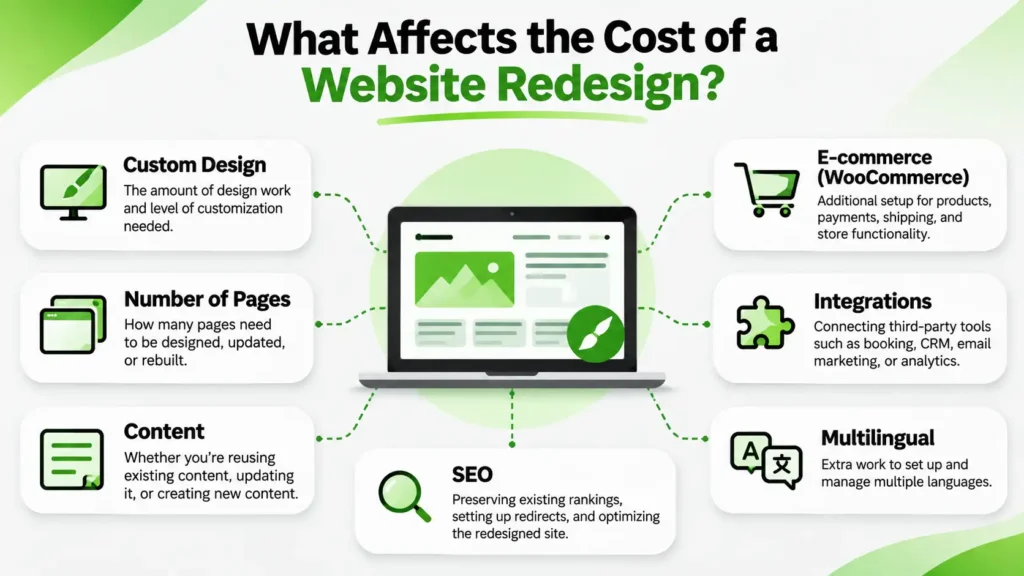
What Affects the Cost of a Website Redesign?
The biggest factors affecting website redesign cost are how custom the design needs to be, the number and complexity of pages, e-commerce functionality, multilingual features, custom development, content requirements, and the depth of SEO work.
In my experience, the price increases when a project requires more than simply giving the existing website a new look. A redesign can involve changing how visitors navigate the site, rebuilding page layouts, improving the mobile experience, adding functionality, and preserving existing SEO performance.
Custom Design and UI/UX
A website built around an existing design system or template generally requires less work than creating a custom design specifically for the business.
With a custom redesign, the work can include rethinking the layout, navigation, visual hierarchy, calls to action, mobile experience, and how users move through the website.
This is an important distinction because a website redesign isn’t simply changing colors, fonts, and images. If poor navigation or confusing UI and UX are part of the reason for the redesign, those problems need to be solved rather than covered with a new visual style.
Number and Complexity of Pages
More pages can increase the cost, but page count alone doesn’t tell you how much work a redesign requires.
I’ve found that clients sometimes assume every page requires roughly the same amount of work. In practice, redesigning a simple About page is very different from creating a complex service page, product template, booking page, or interactive landing page.
Reusable layouts can also make a significant difference. If 20 service pages use the same template, they don’t necessarily require 20 completely unique designs.
Content and Branding
If the existing copy, images, logo, colors, and overall branding can be reused, there is less new material to create during the redesign.
I’ve worked with websites where the design itself was already good and the real problem was the content. In a situation like that, replacing the entire website would add unnecessary work and cost.
On the other hand, if the redesign also requires new branding, rewritten copy, new images, or major changes to the site’s content structure, the scope becomes larger.
Custom Functionality and Integrations
Custom functionality can quickly change the complexity of a website redesign.
A standard contact form is very different from developing or integrating features such as booking systems, advanced forms, customer accounts, third-party services, or functionality created specifically for the business.
Before requesting a quote, it helps to separate functionality the website needs from features that would simply be nice to have.
E-Commerce and WooCommerce
An e-commerce redesign usually involves more than redesigning the homepage and a few standard pages.
From my experience working with furniture stores, WooCommerce websites can include product and category templates, large product catalogs, navigation, checkout functionality, and other store-specific elements that need to work together.
A store with hundreds of products therefore has a very different scope from a five-page service-business website.
Multilingual Websites
Adding multiple languages can also increase website redesign costs because there is more content and functionality to manage.
Depending on the project, the redesign may need to account for translated versions of pages, menus, templates, URLs, and other website elements.
If the existing multilingual setup can be preserved, the work may be smaller than implementing a completely new multilingual structure.
SEO and Website Migration
The deeper the SEO work required during a redesign, the larger the scope can become.
This is particularly important when the existing website already ranks in search results. One of the things I pay attention to during redesign projects is preserving the SEO value the website has already built.
For example, if an existing URL needs to change, the old URL shouldn’t simply disappear. A proper 301 redirect can send visitors and search engines to the relevant new location.
A redesign involving significant URL changes, content restructuring, internal linking, or other SEO migration work therefore requires more planning than redesigning a website with little existing search visibility.
Our website redesign checklist covers the SEO and technical checks that should happen before the redesigned site goes live.
What Increases or Reduces Website Redesign Cost?
The same website can become considerably more or less expensive depending on what can be preserved from the existing site.
| Factor | Lower-Cost Scenario | Higher-Cost Scenario |
|---|---|---|
| Design | Existing system can be adapted | Fully custom design |
| Content | Existing content is reusable | New or substantially rewritten content |
| Branding | Existing branding remains | New branding or visual direction |
| Pages | Small number of simple pages | Many unique or complex pages |
| Functionality | Standard website functionality | Custom functionality and integrations |
| E-commerce | No online store | WooCommerce or complex e-commerce |
| Languages | One language | Multilingual website |
| Platform | Staying on WordPress | Platform migration or major rebuild |
| SEO | Limited changes to existing structure | Deeper SEO and migration work |
| Images & Copy | Supplied by the client | Need to be created or sourced |
Not sure what your website actually needs?
We can evaluate your current website and help you determine whether you need a few targeted improvements, a redesign, or a complete rebuild.
Website Update vs Refresh vs Redesign vs Rebuild: What’s the Difference?
A website update, refresh, redesign, and rebuild are not the same thing—and understanding the difference can prevent you from paying for more work than your website actually needs.
A business that needs a few content and layout improvements shouldn’t automatically pay for a complete rebuild. At the same time, repeatedly patching a website with poor UI/UX, outdated design, or structural problems may not be the best long-term solution.
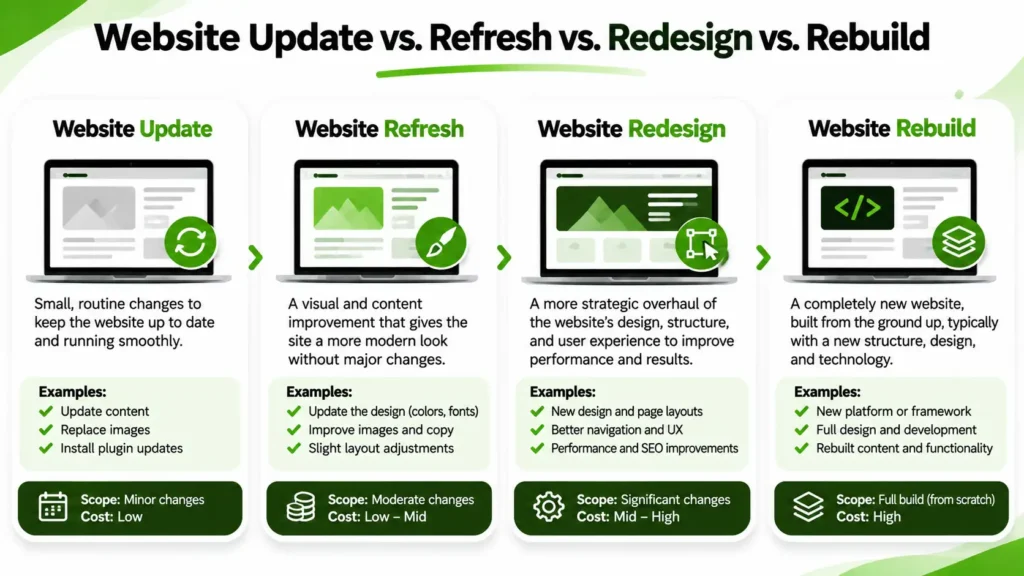
Website Update
A website update involves smaller changes without significantly changing the overall design or structure of the site.
This could include replacing outdated copy, changing images, adding a new section, updating contact information, or making improvements to individual pages.
If the website already looks good and works well, updates may be all that’s necessary. I’ve encountered websites where the client initially considered a larger redesign, but the existing design was good and the content was what actually needed attention.
Website Refresh
A website refresh goes further than routine updates but keeps much of the existing website intact.
It might include improving colors and typography, modernizing certain sections, cleaning up layouts, improving mobile presentation, or making navigation easier to use.
A refresh can make sense when the foundation of the website is still solid but the site needs modernization rather than a completely new direction.
Website Redesign
A website redesign involves more substantial changes to how the website looks and works.
This can include a new visual direction, redesigned page templates, improved navigation, better mobile layouts, changes to the content structure, stronger calls to action, and improvements to UI and UX.
In my experience, a full redesign becomes more appropriate when the existing design itself is part of the problem—for example, when the website feels outdated, is difficult to navigate, provides a poor mobile experience, or isn’t effectively guiding visitors toward the next step.
Website Rebuild
A website rebuild goes deeper and replaces a significant part of the existing website’s implementation.
That might mean rebuilding templates and functionality, replacing an outdated technical setup, moving to another platform, or creating a new website while preserving the content and SEO elements that are still valuable.
A rebuild can therefore involve much more development work than a visual refresh.
Update vs Refresh vs Redesign vs Rebuild
| Type | Typical Changes | Best When | Relative Scope |
|---|---|---|---|
| Website update | Copy, images, sections, individual page changes | The website already works and only specific elements need changing | Low |
| Website refresh | Styling, layouts, mobile improvements, navigation refinements | The foundation is good but the site needs modernization | Low–Medium |
| Website redesign | UI/UX, page templates, navigation, visual direction, content structure | The existing experience or design is limiting the website | Medium–High |
| Website rebuild | Major development, functionality, templates, platform, or technical structure | The existing implementation is no longer suitable | High |
The terminology can vary between developers and agencies, so the name attached to the project matters less than what is actually included in the scope.
Before comparing website redesign prices, compare what each quote actually proposes to change. One provider’s “redesign” could be another provider’s “refresh,” which is one reason two quotes can look very different.
Do You Actually Need a Full Website Redesign?
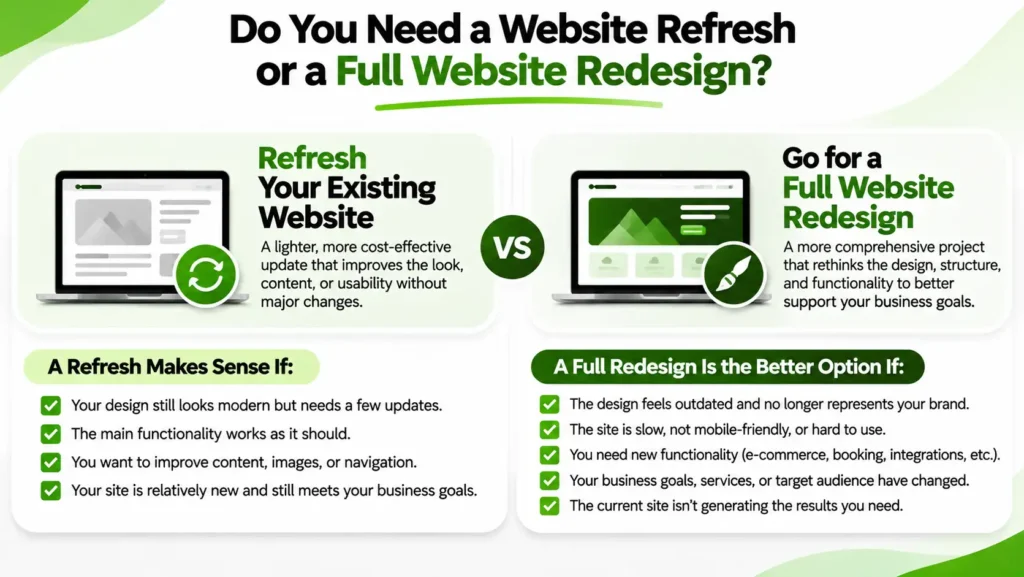
Not every underperforming or older website needs a complete redesign. If the underlying design, structure, and user experience still work well, targeted improvements may solve the problem for less time and cost.
I’ve worked with businesses that initially considered redesigning their website, but after looking at the existing site, the design itself wasn’t the problem. The content needed to be updated instead. Rebuilding a website that already has a solid foundation would have added unnecessary work without addressing the real issue.
When a Website Refresh May Be Enough
A smaller website refresh may be enough when:
- the overall design still represents the business well
- navigation is clear and easy to use
- the website works properly on mobile devices
- the existing platform and functionality are still suitable
- only certain pages or sections feel outdated
- the content, images, or calls to action are the main problem
For example, if visitors can easily navigate the site but the service descriptions are outdated, redesigning every page may not improve the result. Updating the content and strengthening key pages could be the better investment.
The same applies when only a few sections look dated. Those areas can often be improved without replacing the entire website.
When a Full Website Redesign Makes More Sense
A full redesign becomes more appropriate when the problems affect the website as a whole rather than one or two individual elements.
Some of the most common problems I see include outdated design, slow performance, confusing navigation, poor UI and UX, and a weak mobile experience.
If visitors struggle to understand where to go, important information is difficult to find, or the mobile version makes the website frustrating to use, changing a few colors or rewriting the homepage won’t solve the underlying problem.
A redesign can then address the experience more broadly by improving the site’s structure, navigation, page layouts, responsive design, and how visitors are guided toward important actions.
The key is to diagnose the problem before deciding on the solution. A website shouldn’t be redesigned simply because it has been online for a certain number of years. It should be redesigned when its current design, experience, or functionality is no longer serving the business effectively.
You can also explore our web design portfolio to see how different businesses required different website solutions.
Is It Cheaper to Redesign a Website or Build a New One?
Not necessarily. A website redesign can cost roughly the same as building a new website when significant design, development, functionality, content, or SEO work is required. The fact that a website already exists doesn’t automatically make the project easier.
From my experience, new websites and redesigns often involve a similar amount of work, but that work happens in different places.
With a new website, you’re starting with a clean foundation. That can involve configuring the hosting and WordPress installation, establishing the site structure, creating the design system, and building everything from the beginning.
With a redesign, some of that foundation already exists—but you first need to understand what you’re working with. Existing content, pages, functionality, plugins, URLs, and SEO value may need to be evaluated before deciding what should stay, what should change, and what should be rebuilt.
When a Redesign Can Cost Less
A redesign can be less expensive when much of the existing website is still usable.
For example, costs can stay lower when:
- the website remains on WordPress
- existing content can be reused
- the branding already works
- the page structure requires only minor changes
- existing functionality can remain
- the client already has suitable images and copy
In this situation, you’re improving an existing foundation rather than replacing it.
When Starting Fresh Can Make More Sense
There are also cases where repeatedly fixing an existing website creates more work than rebuilding it properly.
I’ve encountered websites where the design itself wasn’t working well and wasn’t effectively converting visitors. When the problems extend across the design, navigation, mobile experience, UI/UX, and underlying structure, preserving everything simply because it already exists may not be the best approach.
This is why comparing the price of a “redesign” versus a “new website” without comparing the actual scope can be misleading.
The better question is:
How much of the existing website is worth keeping?
If most of the content, structure, branding, and functionality can remain, a redesign may require less work. If nearly everything needs to change, the project can start looking much more like a new website build—and the cost can reflect that.
How Much Does a Small Business Website Redesign Cost?
For the types of small-business websites I work on, a website redesign can range from around $400 to $1,500+, depending on the scope. This is based on my own project experience and shouldn’t be treated as a universal average for every freelancer or web design agency.
A relatively simple WordPress redesign can stay closer to the lower end when the business already has usable content and branding, only needs a small number of pages, and doesn’t require custom functionality.
The price can increase when the project involves custom design, WooCommerce, multiple languages, complex functionality, integrations, or more extensive SEO work.
What Can You Expect at Different Budget Levels?
It’s tempting to compare redesign providers based only on price, but two quotes can represent completely different amounts of work.
For example, a lower-budget project might focus on redesigning a small WordPress website while keeping the existing branding and content. A larger project could include custom UI/UX, new page templates, content work, e-commerce functionality, integrations, and an SEO migration.
That means a $500 redesign and a $10,000 redesign aren’t necessarily competing versions of the same service.
One could be a focused implementation by a freelancer or smaller agency, while the other could involve strategy, research, copywriting, custom design, development, SEO, testing, and several specialists.
WordPress can also be built in different ways; our guide to Elementor alternatives compares other approaches available for WordPress sites.
Why Do Some Website Redesigns Cost $10,000 or More?
Higher website redesign prices can make sense when the scope requires substantially more resources.
Larger projects may include:
- UX research and strategy
- completely custom UI design
- custom development
- copywriting
- photography or other media production
- advanced integrations
- e-commerce functionality
- extensive SEO migration
- testing and quality assurance
- dedicated project management
Larger agencies also typically have multiple specialists involved in a project, which creates a different cost structure from working with an individual freelancer or a smaller web design agency.
This doesn’t mean that a small business automatically needs an expensive redesign. It also doesn’t mean that the cheapest quote is automatically the better value.
The important question is what work is actually included for the price.
For a small local business with a straightforward WordPress website, existing branding, reusable content, and standard functionality, a large custom-agency project may simply be unnecessary. But a business with a large website, e-commerce store, complex integrations, or significant SEO visibility may need a much deeper redesign.
The goal should be to choose a redesign scope that matches what the business and website actually need—not an arbitrary budget simply because another company spent that amount.
Planning a website redesign?
Tell us what you want to improve, and we’ll recommend a redesign scope based on your website, goals, and functionality—not a one-size-fits-all package.
What Does Website Redesign Cost Look Like for Different Businesses?
Website redesign cost can vary considerably between industries because different businesses need their websites to do different things. A service-based website, a portfolio website, and an e-commerce store may all have a similar number of pages but require very different design and development work.
I’ve worked on websites for med spas, architecture businesses, and furniture stores, and these projects are good examples of why scope matters more than page count alone.
Med Spa or Service Business Website
A med spa or other service-based business typically needs the website to do more than simply explain what the company offers.
Individual services may require dedicated pages, visitors need clear paths toward booking or contacting the business, and the mobile experience is particularly important when potential customers are browsing from their phones.
Depending on the existing website, a redesign may involve:
- redesigning service pages
- improving navigation between services
- strengthening calls to action
- improving the mobile experience
- integrating an existing booking platform
- improving page speed
- preserving existing SEO during the redesign
If the business already has strong branding, usable service content, and a working booking system, those elements can often be retained instead of recreated.
Architecture or Portfolio Website
An architecture website has different priorities.
The work itself needs to be presented clearly, so project pages, portfolios, imagery, typography, and overall visual presentation can require more attention during the redesign.
A redesign might focus on:
- custom portfolio and project layouts
- image presentation
- responsive galleries
- navigation between projects and services
- visual hierarchy
- multilingual content
- performance on image-heavy pages
A relatively small architecture website can therefore require significant design work even if it doesn’t contain hundreds of pages.
For architecture firms, the website and search strategy also need to work together; our guide to SEO for architects explains that side in more detail.
See how we approached the Smarx Architecture website redesign when its growing portfolio had become difficult to manage.
Furniture or E-Commerce Website
An online furniture store can be significantly more complex because the redesign affects both the website’s presentation and its shopping functionality.
I’ve worked with furniture websites containing hundreds of products, where the scope extends far beyond redesigning a homepage.
The project may involve:
- WooCommerce
- product and category templates
- large product catalogs
- product navigation
- responsive product pages
- checkout and store functionality
- performance optimization
- existing product content
- SEO considerations
This is why comparing an e-commerce redesign with a five-page business website based purely on price doesn’t provide much useful information.
The industry itself doesn’t determine the website redesign cost—the requirements do. These examples simply show how different business models create different design, development, functionality, and SEO requirements even when each project is described as a “website redesign.”
You can see more examples of our WooCommerce and e-commerce website projects in the MaTox portfolio.
Freelancer vs Web Design Agency: How Does It Affect Redesign Cost?
Who you hire can have a significant effect on website redesign cost. A freelancer or smaller agency will often have a different pricing structure from a larger web design agency with strategists, designers, developers, copywriters, SEO specialists, and project managers involved.
However, the cheapest quote and the most expensive quote may not include the same work, so comparing price alone can be misleading.
Working With a Freelancer
A freelancer can be a good fit for small-business redesigns with a clearly defined scope.
Because you’re usually working directly with the person designing or developing the website, the process can be simpler and the overhead lower than with a larger agency.
Freelancers can be particularly suitable when the project involves:
- a small or medium-sized WordPress website
- an existing brand and content
- standard website functionality
- a defined number of pages
- improvements to an existing design
- a straightforward redesign without a large multidisciplinary team
The important thing is to check exactly what the freelancer handles. One may provide both design and development, while another may require you to supply finished designs, copy, SEO work, or other parts of the project separately.
Working With a Web Design Agency
A web design agency can make more sense when the project requires several areas of expertise or has a larger and more complex scope.
Depending on the agency and project, the quote might include strategy, UX research, UI design, development, copywriting, SEO, testing, and project management.
This can make the overall website redesign price higher, but you’re also potentially paying for a broader scope of work.
For larger websites, complex e-commerce stores, custom functionality, or projects involving significant research and strategy, having multiple specialists involved can be valuable.
Which Should a Small Business Choose?
Neither option is automatically better. The right choice depends on the complexity of the project and the expertise you need.
A straightforward small-business WordPress redesign may not require a large team. On the other hand, choosing the lowest quote for a complex website can become expensive later if important work wasn’t included in the original scope.
When comparing redesign quotes, look beyond the final price and ask:
- Is the design custom or template-based?
- Is responsive design included?
- Who handles the content?
- Is SEO included?
- Are existing URLs and redirects considered?
- Are integrations included?
- Is e-commerce functionality included?
- Are revisions included?
- Is testing included?
- What happens after the website launches?
This is also why comparing a custom website redesign with a basic template installation isn’t a fair comparison. They may both result in a new-looking website, but the amount of strategy, design, development, and optimization behind them can be completely different.
Learn more about MaTox Digital Agency and how we combine design, development, performance, and SEO.
How Can You Reduce Website Redesign Costs?
You can reduce website redesign costs by keeping the parts of your existing website that still work and avoiding unnecessary custom work. The goal shouldn’t be to make the project as cheap as possible—it should be to avoid paying to replace things that don’t need replacing.
In my experience, redesign projects tend to stay more affordable when the existing content and branding can be reused, the website has a smaller page count, the client provides the copy and images, and the project doesn’t require extensive custom functionality.
Reuse Good Existing Content
A redesign doesn’t mean every piece of content needs to be rewritten.
If your service descriptions, About page, product information, images, or other content are still accurate and useful, they can often be transferred into the new design.
This reduces the amount of content work required and allows more of the budget to go toward areas that actually need improvement.
Keep Existing Branding When It Still Works
The same applies to branding.
If your logo, colors, typography, and overall brand identity still represent the business well, there’s no reason to create a completely new brand simply because the website is being redesigned.
A website redesign and a rebrand are two different projects. Combining them can make sense when both are needed, but it also increases the scope.
Stay on Your Existing Platform When It Still Meets Your Needs
Moving from one website platform to another can introduce additional work.
If your existing WordPress setup still meets the needs of the business, staying on WordPress can simplify the redesign compared with migrating the entire website to another platform.
A platform migration may require additional work around content, functionality, URLs, integrations, and SEO, so there should be a clear reason for making the move.
Provide Your Copy and Images
If you already have professional images and finished website copy, providing those materials can reduce the amount of work included in the redesign.
It can also help the project move more efficiently because the designer isn’t building pages around missing content that may later change the layout.
However, existing content should still be evaluated before automatically reusing everything. If weak content is one of the reasons the current website isn’t performing well, keeping it simply to reduce the redesign cost can work against the purpose of the project.
Avoid Custom Functionality You Don't Actually Need
Custom functionality can add significant development work.
Before adding a feature, ask whether it solves a genuine business or user problem.
A business may need online booking, e-commerce, multilingual functionality, or a particular integration. But adding custom features simply because they look impressive can increase the website redesign price without necessarily improving the result.
Define the Scope Before the Redesign Starts
One of the best ways to control website redesign costs is to clearly define what needs to change before development begins.
Identify which pages are staying, which need redesigning, what content can be reused, what functionality is required, and whether SEO or platform migration work is involved.
This also makes quotes easier to compare because you’re giving different providers a clearer picture of the same project.
Reducing website redesign cost isn’t about cutting everything possible. It’s about spending the budget on the parts of the website that actually need improvement.
If you’re considering changing platforms rather than staying on WordPress, our Wix vs Squarespace comparison explains some of the differences between popular website builders.
Don’t Forget SEO When Redesigning Your Website
A website redesign can improve how your site looks and works, but SEO needs to be considered before the new version goes live. If an existing website already ranks in Google, changing URLs, removing pages, or restructuring content without a plan can put some of that existing search visibility at risk.
This is one reason deeper SEO work can increase the cost of a website redesign. You’re not only designing new pages—you also need to consider what the existing website has already built.
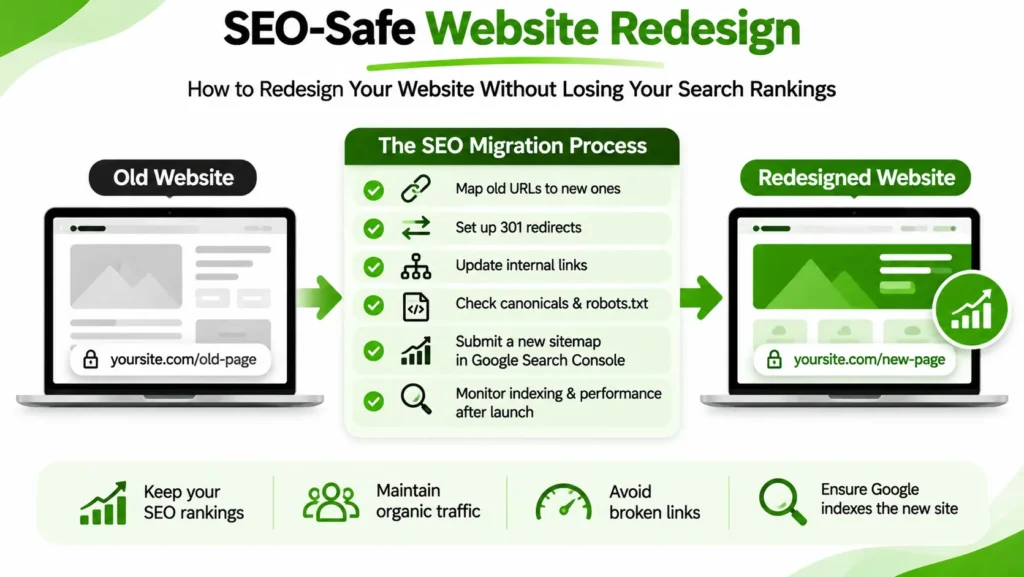
Preserve Existing URLs Where Possible
If an existing page already performs well and its URL still makes sense, changing it unnecessarily can create additional migration work.
During a redesign, I prefer to first determine what can be preserved rather than automatically changing the entire URL structure just because the website is getting a new design.
This is especially important for established service pages, blog posts, product pages, and other URLs that may already receive organic traffic.
Use 301 Redirects When URLs Change
Sometimes URL changes are necessary.
A page may be removed, several pages may be consolidated, or the website structure may change during the redesign. In those situations, one of the things I pay particular attention to is setting up the appropriate 301 redirects.
Instead of allowing an old URL to lead to a 404 page, it should generally redirect to the most relevant replacement page when an appropriate replacement exists.
This helps visitors and search engines find the new location after the redesigned website launches.
Protect the SEO Work the Website Already Has
URLs aren’t the only SEO consideration.
A redesign can also affect:
- page content
- headings
- title tags and meta descriptions
- internal links
- canonical URLs
- structured data
- navigation
- crawlability
- XML sitemaps
- indexability
This doesn’t mean every redesign requires an extensive SEO campaign. A small website with little existing organic visibility may require much less migration work than an established website receiving traffic from dozens or hundreds of ranking pages.
But if SEO is already bringing visitors to the business, preserving that value should be part of the redesign scope—not something checked after the new website has already launched.
This is why two visually similar redesign projects can have different costs. One may simply require new layouts, while another needs careful SEO migration work alongside the design and development.
How Long Does a Website Redesign Take?
A website redesign can take anywhere from a few weeks to several months, depending on the size of the website, how much needs to change, the functionality involved, and how quickly content and feedback are provided.
Just like website redesign cost, there isn’t one timeline that applies to every project. Updating a small WordPress website with reusable content is very different from redesigning a large WooCommerce store or a website that requires custom functionality, multiple languages, and SEO migration.
What Can Make a Website Redesign Take Longer?
Some of the same factors that increase the cost can also extend the timeline, including:
- custom UI and design work
- a large number of unique pages
- WooCommerce or e-commerce functionality
- custom development and integrations
- multilingual functionality
- creating or rewriting content
- migrating large amounts of existing content
- SEO migration and redirects
- testing complex functionality
The timeline can also depend on how quickly decisions are made. Waiting for copy, images, approvals, or feedback can delay a project even when the design and development work itself is progressing normally.
Why a Faster Redesign Isn’t Always Better
Getting a redesigned website live quickly can be useful, but speed shouldn’t come at the expense of important work.
For an existing website, there may be content worth keeping, functionality that needs testing, mobile layouts that need checking, and existing SEO value that needs protecting before launch.
This becomes particularly important when the website already generates traffic, leads, bookings, or sales.
Instead of choosing a redesign provider based only on who promises the fastest turnaround, ask what is included in that timeline and what will be tested before the new website goes live.
A realistic redesign schedule should leave enough time to properly design, build, test, and launch the website without unnecessarily dragging the project out.
What Costs Might Not Be Included in a Website Redesign Quote?
A website redesign quote doesn’t always include every expense connected to the project. Before comparing prices, check exactly what is included and what you may need to pay for separately.
This is another reason two website redesign quotes can look very different. One provider may quote only for design and development, while another may include SEO, content, premium tools, integrations, and post-launch support.
Hosting and Domain Costs
Hosting and domain registration are typically separate from the actual website redesign service.
If you’re staying with your existing hosting provider, there may be nothing new to purchase. However, a redesign can sometimes reveal that the current hosting setup isn’t suitable for the new website, particularly when performance or e-commerce requirements increase.
Premium Plugins and Third-Party Tools
Some websites require paid plugins, software, or external services.
This could include functionality for booking, multilingual content, advanced forms, e-commerce features, or other integrations.
Before the project begins, clarify whether these licenses are included in the redesign quote or whether your business will purchase and maintain them separately.
Copywriting and Content
Don’t assume that new website copy is automatically included.
If your existing content can be reused, this may not be an issue. But if service pages, product descriptions, landing pages, or other content need to be rewritten, content creation can become a separate part of the project.
The same applies to migrating large amounts of existing content into the redesigned website.
Photography, Video, and Other Visual Assets
Professional photography, video, illustrations, or premium stock assets may also fall outside the core website redesign price.
Providing your own high-quality images can reduce this part of the scope, but the assets still need to work with the new design.
SEO Work
Basic SEO setup and a full SEO migration are not the same service.
If an existing website already has organic visibility, preserving URLs, planning redirects, reviewing content changes, and protecting important SEO elements can require additional work.
This is worth clarifying before accepting a quote rather than assuming SEO will automatically be handled because the website is being redesigned.
Ongoing Maintenance and Support
The redesign project may end when the new website launches, while ongoing maintenance is handled separately.
Depending on the website, future costs might include hosting, software renewals, updates, backups, security, technical support, content updates, or ongoing SEO.
None of these costs are automatically a problem. The important thing is to know what the initial website redesign price includes and what becomes an ongoing expense after launch.
When comparing quotes, ask for a clear scope rather than looking only at the total. A cheaper proposal can become more expensive than expected if several essential parts of the project aren’t included.
How Should You Budget for a Website Redesign?
To set a realistic website redesign budget, start by defining what actually needs to change rather than choosing a price first. The clearer the scope is, the easier it becomes to estimate the work and compare quotes from different providers.
This is where the principle we’ve used throughout this guide matters most:
Price follows scope.
A business that already has usable content, established branding, and a functional WordPress website will have very different requirements from one that needs a custom design, new content, WooCommerce, multiple languages, integrations, and an SEO migration.
Ask These Questions Before Requesting a Website Redesign Quote
Before contacting a freelancer or web design agency, consider:
- How many pages actually need redesigning? Some pages may be reusable with only minor changes.
- How many unique page layouts are required? Ten pages using two templates can require less design work than five completely different pages.
- Can the existing content be reused? Decide what can stay and what needs to be rewritten.
- Is the existing branding staying? A redesign combined with a rebrand creates additional work.
- Do you need custom functionality? Identify required features before development begins.
- Does the website need e-commerce? WooCommerce adds requirements that a standard business website doesn’t have.
- Do you need multiple languages? Multilingual functionality increases the amount of content and setup involved.
- Are third-party integrations required? Booking systems and other external tools should be identified early.
- Are you staying on the same platform? Moving platforms can introduce additional development and migration work.
- Does the existing website have SEO visibility? Existing rankings, URLs, and content may need to be protected during the redesign.
- Who will provide the copy and images? Having these ready can reduce both cost and delays.
Website Redesign Budget Checklist
Before comparing quotes, you can use this simple framework to get a better idea of your project’s complexity:
| Question | Lower-Complexity Project | Higher-Complexity Project |
|---|---|---|
| How much needs changing? | Selected pages or sections | Most or all of the website |
| Design | Existing style can be adapted | Fully custom direction |
| Content | Mostly reusable | Significant new content |
| Branding | Already established | Rebrand required |
| Page layouts | Mostly reusable templates | Many unique layouts |
| Functionality | Standard features | Custom functionality |
| E-commerce | No | WooCommerce or online store |
| Languages | One language | Multiple languages |
| Integrations | Few or none | Multiple or complex integrations |
| Platform | Staying on current platform | Platform migration required |
| SEO | Limited migration work | Existing visibility must be carefully migrated |
| Assets | Copy and images ready | New assets need to be created |
If most of your answers fall on the left, your redesign will generally have a smaller scope. If many fall on the right, you should expect a larger project and budget.
This framework is also useful when comparing proposals. Instead of asking only “How much should a website redesign cost?”, check whether each provider is actually quoting for the same requirements.
A $1,000 quote that covers design and development isn’t directly comparable to a $5,000 quote that also includes copywriting, custom functionality, SEO migration, and additional services.
Define what you need first, then compare the price of delivering that scope.
Is a Website Redesign Worth the Cost?
A website redesign can be worth the cost when the existing site is actively making it harder for visitors to use the website, trust the business, or take the next step. But if the website already works well and only a few areas need improvement, a full redesign may not be the best investment.
The goal of a redesign shouldn’t simply be to make the website look newer. It should solve specific problems that are affecting the business.
When a Website Redesign Can Be Worth It
From the websites I’ve worked on, some of the clearest reasons to consider a redesign are:
- outdated design that no longer represents the business
- confusing navigation
- poor UI and UX
- weak mobile experience
- slow website performance
- layouts that don’t guide visitors toward important actions
- functionality that no longer meets the needs of the business
If several of these problems exist across the website, continuously making small fixes can eventually become less practical than addressing the site more comprehensively.
For example, changing the homepage won’t solve much if visitors still struggle with navigation, service pages are difficult to use on mobile, and the overall user experience remains confusing.
When a Full Redesign May Not Be Worth It
A redesign isn’t automatically the right solution just because a website is several years old.
I’ve seen websites where the existing design was still good, but the content needed to be updated. In that situation, rewriting and improving the content made more sense than replacing a design that was already doing its job.
The same can apply when the problem is limited to a few pages, slow performance, weak calls to action, or another specific issue that can be addressed independently.
Before investing in a redesign, identify what is actually preventing the current website from performing better.
If the problem can be solved with targeted improvements, start there. If the problems are spread across the design, navigation, mobile experience, functionality, and overall UI/UX, a more complete redesign becomes easier to justify.
Ultimately, whether the website redesign cost is worth it depends on what you’re getting in return—not simply how different the new website looks.
If WordPress performance is one of the reasons you’re considering a redesign, see the WordPress cache plugins I tested and how they affected performance.
Frequently Asked Questions About Website Redesign Cost
How Much Does It Cost to Redesign a Website?
A website redesign can cost anywhere from a few hundred dollars to tens of thousands of dollars, depending on the scope. In the small-business projects I’ve worked on, redesign costs can range from around $400 to $1,500+, while custom, e-commerce, and larger agency projects can cost significantly more.
What Is the Average Website Redesign Cost?
There isn’t one average website redesign cost that applies to every project. The price depends on factors such as custom design, page complexity, content, WooCommerce, multilingual functionality, integrations, SEO work, and how much of the existing website can be reused.
How Much Should a Small Business Website Redesign Cost?
For the types of small-business websites I work on, redesign projects can range from around $400 to $1,500+. However, this is my own project range rather than a universal market average. A small WordPress service website and a custom e-commerce website require very different amounts of work.
Is It Cheaper to Redesign or Build a New Website?
Not always. A redesign can be less expensive when existing content, branding, structure, and functionality can be reused. However, if most of the existing website needs to be replaced, the amount of work can become similar to building a new website.
How Long Does a Website Redesign Take?
A website redesign can take a few weeks to several months, depending on the size and complexity of the project. Custom design, e-commerce, integrations, multilingual functionality, content creation, SEO migration, and delays in receiving feedback or assets can extend the timeline.
Will Redesigning My Website Hurt My SEO?
A redesign doesn’t automatically hurt SEO, but mistakes during the migration can affect existing search visibility. Important URLs, content, internal links, metadata, indexability, and other SEO elements should be considered, and appropriate 301 redirects should be implemented when URLs change.
How Often Should You Redesign Your Website?
There is no fixed number of years after which every website needs to be redesigned. A redesign makes more sense when the current website no longer serves the business effectively—for example, because of poor mobile usability, outdated design, confusing navigation, weak UI/UX, performance problems, or functionality that no longer meets the business’s needs.
A website that still performs well may only need targeted updates rather than a complete redesign.
Final Thoughts: Website Redesign Cost Depends on What You Actually Need
There is no single website redesign cost that makes sense for every business. A small WordPress website with reusable content and existing branding can require relatively little work, while a custom e-commerce, multilingual, or SEO-heavy redesign can become a much larger project.
That’s why the most useful principle to remember is:
Price follows scope.
Before deciding how much to spend, determine what is actually wrong with your current website and what needs to change. You may need a complete redesign, but you may also discover that better content, improved navigation, faster performance, or updates to a few important pages are enough.
From my experience working with small-business websites, the best redesigns aren’t necessarily the ones that change everything. They’re the ones that keep what already works and improve what doesn’t.
If you’re comparing website redesign quotes, look beyond the final number. Compare the design work, functionality, content, SEO, integrations, support, and other services included in each scope.
Ultimately, the right website redesign budget is the one that solves the problems your current website has without paying to rebuild things that are already working.
Ready to improve your website?
MaTox Digital Agency designs and develops responsive, conversion-focused websites for small businesses, with SEO considered throughout the process. Explore our website design portfolio.

About the Author
Makedonka Tochevska
Makedonka Tochevska is the founder of MaTox Digital Agency and a web designer and front-end developer. She works on website design and redesign projects with a focus on WordPress development, user experience, website performance, and SEO implementation.
Her work includes planning and building business websites, construction and architecture websites, improving existing websites, and handling the technical and SEO details that need to be considered when a website changes.