
SEO for Construction Companies: How to Rank Higher and Get More Leads
By Makedonka Tochevska · Last Edited October 2026
SEO for construction companies works best when your website clearly shows what you build, where you work, and why potential clients should trust your company. That means targeting the right searches with dedicated service and location pages, optimizing your Google Business Profile, turning completed projects into useful website content, earning reviews, and making sure search engines can properly crawl and understand your site.
But rankings and traffic aren’t the end goal. A construction SEO strategy should help potential clients find the right service or project at the moment they’re looking for it and give them enough information and proof to contact your company.
TL;DR: SEO for Construction Companies
- Construction SEO starts with matching the right services, locations, and search intent to the right pages on your website.
- Create dedicated service pages instead of expecting one general Services page to rank for everything your company offers.
- Local visibility matters, especially for residential and locally focused construction companies. Your Google Business Profile, reviews, service areas, and website should support each other.
- Don’t create dozens of near-identical city pages. A useful location page needs genuine local relevance, unique information, and connections to the services and projects you actually provide there.
- Treat completed projects as SEO assets, not just image galleries. Add useful context about the location, scope, services, challenges, work completed, and results alongside the photography.
- Construction websites can be image-heavy without being unnecessarily slow. Correct image dimensions, modern formats, compression, and good technical implementation make a significant difference.
- Build trust with real projects, reviews, years of experience, team information, certifications or licenses where relevant, and clear contact information.
- Measure success beyond rankings and traffic. Calls, quote requests, qualified leads, project types, and booked work tell you whether your SEO is attracting the right potential clients.
TABLE OF CONTENTS
- What Is Construction SEO?
- Why SEO Matters for Construction Companies
- Residential vs Commercial Construction SEO
- Start With Construction SEO Keyword Research
- Build the Right Construction Website Structure
- Create Individual Pages for Your Construction Services
- Local SEO for Construction Companies: Improve Your Local Visibility
- Create Location Pages Without Creating Thin SEO Pages
- Turn Construction Projects Into SEO Assets
- Optimize Important Construction Pages for On-Page SEO
- Improve Your Construction Website’s Technical SEO and Performance
- Use Reviews to Build Trust and Strengthen Local Visibility
- Build Trust With Real Construction Experience and Proof
- Create Content Potential Construction Clients Actually Search For
- Build Backlinks and Local Authority
- Connect Services, Locations, Projects and Content With Internal Links
- Turn Construction SEO Traffic Into Qualified Leads
- Measure Construction SEO Results That Actually Matter
- What I Would Fix First on an Underperforming Construction Website
- A 90-Day SEO Plan for Construction Companies
- Common Construction SEO Mistakes to Avoid
- SEO for Construction Companies: FAQs
- Final Thoughts: Building an SEO Strategy That Generates Construction Leads
What Is Construction SEO?
Construction SEO is the process of improving a construction company’s website and local presence so it can appear when potential clients search for the services it provides. It includes keyword research, service and location pages, Google Business Profile optimization, project content, reviews, technical SEO, internal linking, and building authority.
What makes construction SEO different from a more generic SEO strategy is the way people search for a company.
Someone rarely searches for just “construction.” They search with a specific need and often a specific location, such as commercial construction company in Dallas, home renovation company near me, or design-build company in Fort Worth.
That means I wouldn’t build a construction SEO strategy around a long list of keywords and try to fit them all onto the homepage. I would first determine what the person searching actually wants, and then decide which page on the website should satisfy that search.
For example:
- Someone searching for a specific construction service should reach a dedicated service page.
- Someone searching for a construction company in a particular area may need a relevant location page.
- Someone researching a problem, cost, material, or construction process may be better served by a useful guide or article.
- Someone evaluating whether the company can handle a project should be able to find completed projects, reviews, and other proof of experience.
Local search is another important part of this. For many construction companies, the website and Google Business Profile need to work together rather than being treated as two separate SEO strategies.
The way I look at it, good construction SEO should make three things immediately clear to both search engines and potential clients: what you do, where you do it, and why someone should trust you to do the work.
Why SEO Matters for Construction Companies
SEO matters for construction companies because many potential clients start looking for a contractor long before they are ready to make contact. They search for companies in their area, compare services, look through completed projects, read reviews, and try to determine which businesses they can trust with the work.
Being visible during those searches gives a construction company more opportunities to attract qualified leads without depending entirely on paid advertising.
But I wouldn’t judge the value of construction SEO by how much traffic a website gets.
A construction company doesn’t necessarily need thousands of visitors every month. A smaller number of people searching for the exact service you provide in an area you actually serve can be far more valuable than a large amount of unrelated traffic.
For example, ranking for a broad informational keyword might generate hundreds of visits without producing a single serious enquiry. A service page that attracts considerably less traffic could generate better opportunities if those visitors are actively looking for a commercial construction company, renovation company, or another specific service.
SEO also gives potential clients more opportunities to evaluate your company before contacting you. They can find your:
- services and areas you serve;
- completed construction projects;
- Google Business Profile and reviews;
- experience and company information;
- answers to questions about their project;
- photos and examples of previous work.
This is especially important in construction because trust usually needs to be established before someone requests a quote. The website shouldn’t simply tell visitors that the company is experienced. The projects, reviews, years of experience, photos, and useful information should provide the proof.
That’s why I think of construction SEO as more than ranking a few pages on Google. The stronger strategy is to build search visibility around the services that can actually become projects and then make sure the website gives those potential clients enough reason to choose your company.
Residential vs Commercial Construction SEO
Residential and commercial construction companies can use many of the same SEO fundamentals, but I wouldn’t approach them with exactly the same strategy. The person searching, the buying process, and the type of proof they need are different.
Residential SEO is usually more locally focused. Homeowners may search for a specific service combined with a city or use “near me” searches, then compare reviews, photos, completed projects, and availability before contacting a company.
Commercial construction SEO often has a longer decision process. Potential clients may be developers, property owners, businesses, architects, or procurement teams looking for specific capabilities and evidence that the company can handle projects similar to theirs.
| SEO Area | Residential Construction | Commercial Construction |
|---|---|---|
| Typical Audience | Homeowners | Businesses, developers, property owners, and procurement teams |
| Search Intent | Service + location searches, “near me” searches, and project questions | Capabilities, project types, specific services, and company experience |
| Local SEO | Often a major priority | Important, but not always the main acquisition channel |
| Strongest Proof | Reviews, local projects, and before-and-after photos | Case studies, project scope, capabilities, and credentials |
| Important Pages | Service, location, project, and review pages | Service, capability, sector, and detailed project pages |
| Buying Process | Usually shorter | Often longer with multiple decision-makers |
Residential Construction SEO
For residential companies, I would put particular emphasis on Google Business Profile, reviews, service pages, relevant location pages, and completed local projects. These elements reinforce each other and help potential clients see that the company genuinely works in their area.
Commercial Construction SEO
For commercial companies, I would spend more time demonstrating capabilities and proof. A detailed project page explaining the scope, type of work, challenges, and solution can be much more useful than a gallery containing twenty photos and almost no text.
The important point is not to copy the same SEO strategy for every construction business. The website should reflect how that company’s actual clients search and make decisions.
Start With Construction SEO Keyword Research
Before creating new pages or publishing more content, I would first determine what potential clients are searching for and which page should target each search.
For construction companies, keyword research should go beyond finding phrases with the highest search volume. A keyword with fewer searches can be much more valuable if the person searching is actively looking for a service your company provides.
Service Keywords
Service keywords describe the work someone is looking for, such as:
- commercial construction company
- general contracting services
- design-build company
- commercial renovation company
- home renovation contractor
These usually belong on dedicated service pages rather than being squeezed onto one general Services page.
Local Keywords
Local keywords add geographic intent:
- construction company in Dallas
- commercial construction company Dallas
- renovation company Fort Worth
- construction company near me
For these searches, your website pages and Google Business Profile should support the same geographic relevance.
Informational Keywords
Not every useful keyword needs to lead directly to a service page. Potential clients also search while researching a project, including questions about costs, timelines, materials, permits, processes, and different construction options.
These searches are better suited to useful articles and resources that can naturally lead readers toward the relevant service or project pages.
What Keywords Should a Construction Company Target?
I would prioritize keywords based on three things: relevance to the services you actually provide, relevance to the locations you serve, and the intent behind the search.
Search volume matters, but it shouldn’t make the decision by itself. I would rather target a lower-volume query closely connected to a real service than attract hundreds of visitors researching something the company doesn’t sell.
Map Keywords to the Correct Pages
This is where keyword research becomes much more useful.
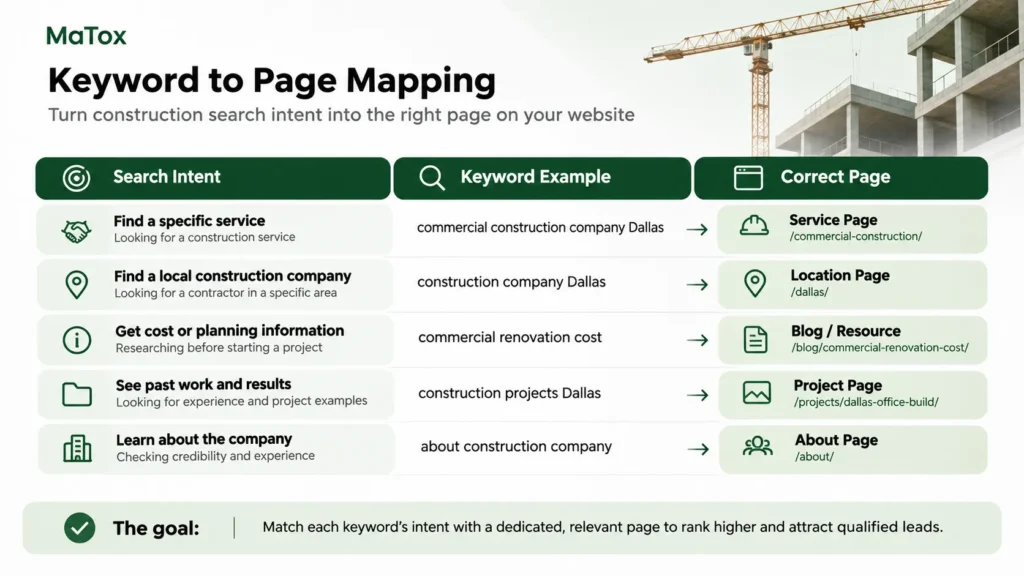
A simple construction SEO keyword map might look like this:
Homepage → construction company [city]
Service page → commercial construction company [city]
Location page → construction company [city]
Project page → commercial office renovation [city]
Blog article → how much does commercial renovation cost
My rule here is simple: one search intent should have one clear primary page.
If several pages are all trying to rank for essentially the same search, you’re making it harder to establish which page Google should consider the best result. The goal isn’t to put every keyword everywhere. It’s to give each important search a logical destination on the website.
Build the Right Construction Website Structure
A construction website should make it easy for both potential clients and search engines to understand what services you offer, where you work, and what kind of projects you have completed.
One mistake I would avoid is putting almost everything on the homepage and relying on a single Services page. If commercial construction, renovations, general contracting, and design-build are important parts of the business, they usually deserve their own pages.
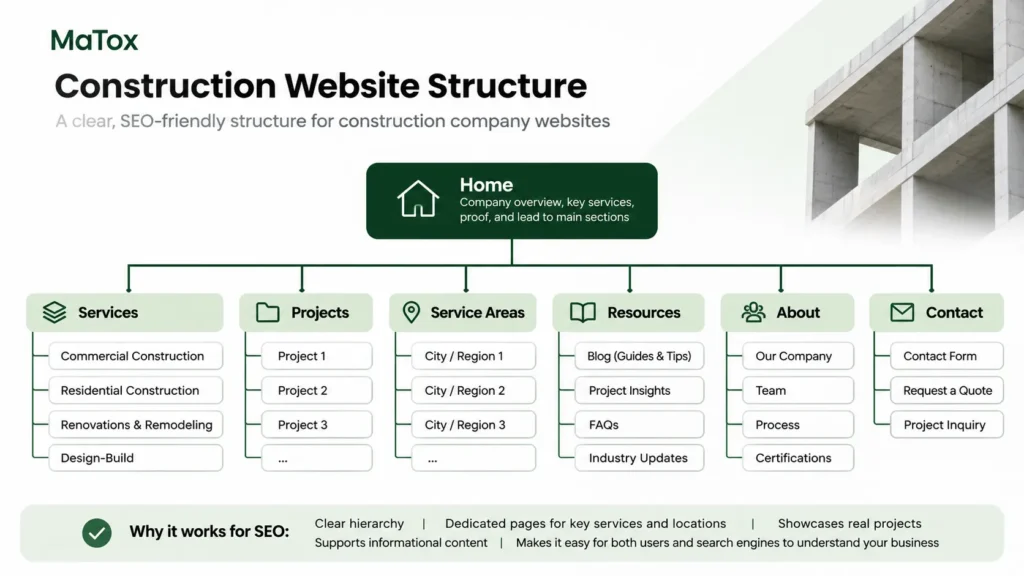
A clear structure could look like this:
Home
├── Services
│ ├── General Contracting
│ ├── Commercial Construction
│ ├── Design-Build
│ └── Renovations
├── Projects
│ ├── Project A
│ ├── Project B
│ └── Project C
├── Service Areas
│ ├── Dallas
│ └── Fort Worth
├── Resources
├── About
└── Contact
What Pages Should a Construction Company Website Have?
I would build the site around four main types of SEO pages:
- Service pages explain what the company does and target searches related to individual construction services.
- Location pages establish relevance for areas the company genuinely serves.
- Project pages prove the company has experience doing the type of work it claims to offer.
- Resources or blog content answer questions potential clients research before choosing a company.
The important part is how these pages work together. A commercial construction service page can link to relevant completed projects. Those projects can link to the location where the work was completed, while an article answering a commercial construction question can lead readers back to the relevant service.
I prefer this kind of structure because you’re not creating pages simply to have more content. Every page has a specific job within the SEO strategy and a logical path toward the services that generate leads.
Create Individual Pages for Your Construction Services
If a construction company offers several distinct services, I recommend giving the important ones their own pages rather than listing everything on one general Services page.
For example:
/commercial-construction//general-contracting//design-build//renovations/
This gives each service a clear place to target its own search intent and, more importantly, gives potential clients a page specifically about the work they’re interested in.
A good construction service page should include more than a short description and a contact button. I would include:
- what the service involves;
- who the service is for;
- the types of projects you handle;
- how your process works;
- relevant completed projects;
- areas where the service is available;
- reviews or other proof related to that work;
- common questions potential clients have;
- a clear next step or quote request.
I also like connecting each service page to real project pages. If you’re telling someone that you specialize in commercial renovations, showing them two or three relevant renovations you’ve completed is much stronger than simply saying you have experience.
The SEO benefit follows naturally: instead of forcing one page to rank for every service, each important service has a focused page supported by projects, internal links, and relevant content elsewhere on the site.
Is Your Construction Website Holding Back Your SEO?
At MaTox Digital Agency, we design and optimize websites around the services, locations, and searches that matter to your business. If your current site isn’t structured to generate organic leads, MaTox can help you build a stronger foundation.
Local SEO for Construction Companies: Improve Your Local Visibility
For construction companies serving specific cities or regions, local SEO can be just as important as traditional organic rankings. When someone searches for a construction company near me or a specific service in their city, Google can show both regular search results and businesses in its local search results.
I treat the website and local presence as parts of the same strategy. Optimizing one while ignoring the other leaves opportunities on the table.
Optimize Your Google Business Profile
Your Google Business Profile should accurately reflect the business and the services it provides. I would pay particular attention to:
- the most appropriate primary and secondary categories;
- accurate service areas;
- construction services offered;
- business description;
- project photos and recent work;
- reviews and responses;
- correct website and contact information.
I’ve worked on Google Business Profile optimization for local businesses, and I wouldn’t treat the profile as something you set up once and forget. Keep the information accurate and continue adding genuine photos, reviews, and relevant updates as the business grows.
Keep Your Business Information Consistent
Your company name, address where applicable, phone number, website, and other important business details should be accurate across your website and important online profiles.
You don’t need hundreds of low-quality directory listings. I would rather focus on accurate profiles on relevant, trustworthy platforms than create listings everywhere simply because an SEO checklist recommends citations.
Build Local Relevance Beyond Google Business Profile
Local SEO doesn’t stop with your profile.
Your website should reinforce where you actually work through service pages, relevant location pages, completed projects, local testimonials, contact information, and naturally placed geographic references.
For example, a detailed project completed in Dallas provides much stronger evidence of genuine local relevance than adding “Dallas construction company” to the footer of every page.
That’s the approach I prefer: show local relevance through real work and useful information instead of repeating city names across the website.
Create Location Pages Without Creating Thin SEO Pages
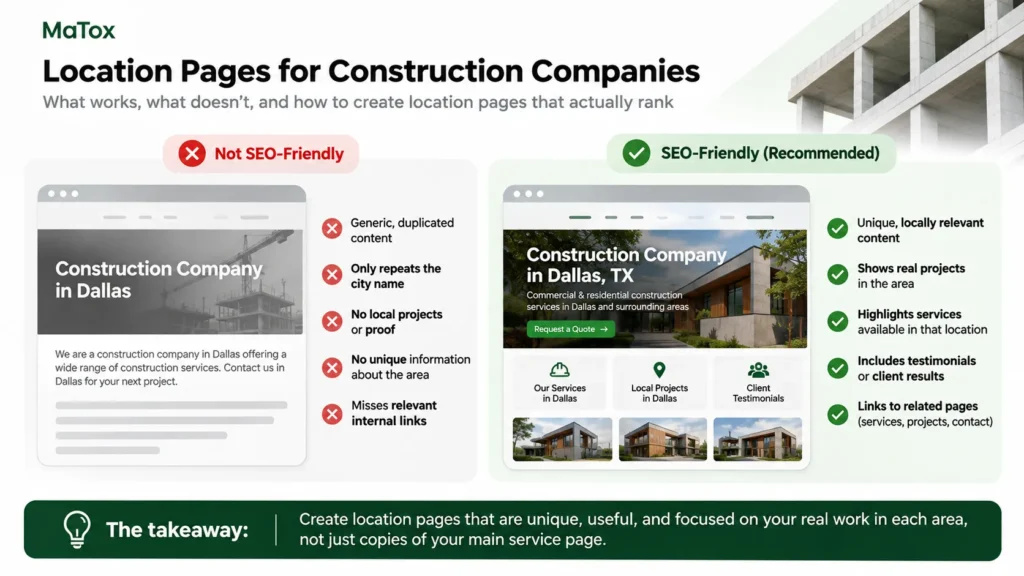
Location pages can help a construction company rank for searches in the cities and areas it genuinely serves, but I wouldn’t create dozens of pages simply because a keyword tool shows search volume.
A useful location page needs a reason to exist beyond changing the city name.
For example, a page targeting construction services in Dallas could include:
- the construction services offered in that area;
- completed projects in or near Dallas;
- original project photos;
- testimonials from local clients;
- relevant information about the types of projects handled there;
- links to individual service and project pages;
- useful local considerations where relevant;
- a clear way to request a quote.
This creates a page that can actually help someone evaluating construction companies in that location.
What I would avoid is creating /dallas/, /fort-worth/, /arlington/, and another 50 pages containing essentially the same text with the city name swapped out. Those pages add very little value to the website or the person searching.
My rule is simple: don’t create a location page just because a keyword has volume. Create it when you have enough real local relevance to make the page genuinely useful.
For construction companies, completed projects are one of the best ways to demonstrate that relevance. If you’ve actually worked in an area, use those projects, photos, services, and client proof to make the location page specific to the work you’ve done there.
Turn Construction Projects Into SEO Assets
One of the biggest missed SEO opportunities I see with project-driven websites is treating the portfolio as a collection of photos instead of useful website content.
The photos absolutely matter. Construction clients want to see the quality of the finished work. But I prefer combining those images with enough written context to explain what was actually done.
Instead of a project page containing a title and 20 photos, turn each important project into a page that can demonstrate experience, support your service and location pages, and potentially appear for more specific searches.
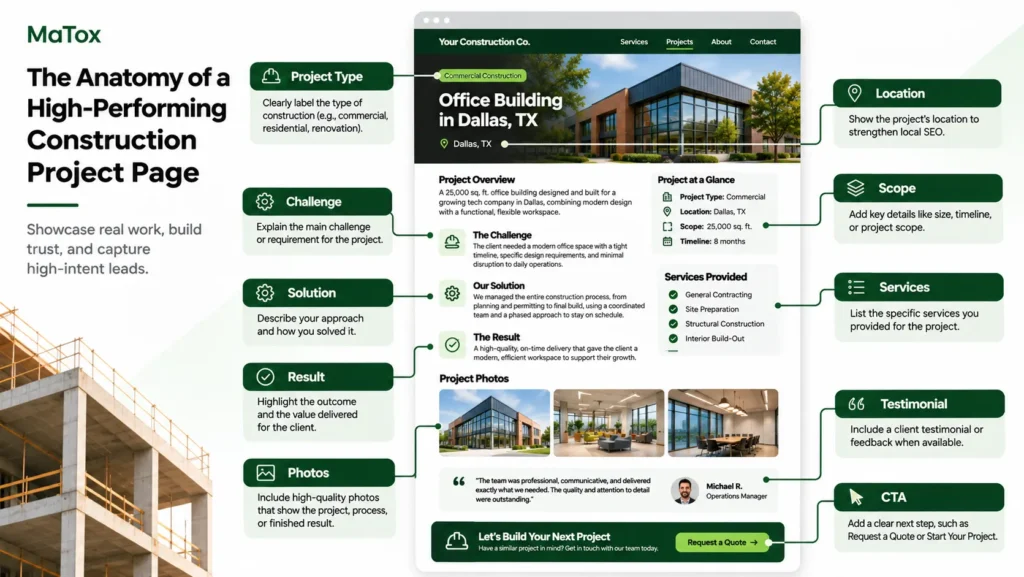
What a Construction Project Page Should Include
For a strong project page, I would include:
- Project type: commercial renovation, new construction, design-build, etc.
- Location: city or service area where the project was completed.
- Scope: what the client needed and what the project involved.
- Services provided: with links to the relevant service pages.
- Challenge: any meaningful problem or requirement the team had to solve.
- Work completed: what was actually done.
- Materials or process: when useful to someone researching similar work.
- Project photos: properly optimized rather than uploaded at unnecessarily large dimensions.
- Result: the completed outcome without exaggerated claims.
- Client testimonial: when available.
- Related projects: to help visitors continue exploring similar work.
- CTA: a clear way to discuss a similar project.
From working on construction, architecture, and furniture websites, I’ve found that image-heavy websites don’t necessarily have to be slow. Using appropriate image dimensions, modern formats, and proper optimization can make a significant difference without sacrificing the project photography these businesses need to showcase their work.
And this is why I wouldn’t publish important projects as image-only galleries. The images prove the quality of the work, while the written content explains the project to potential clients and gives search engines useful context about the service, location, and type of work.
Want More Local Customers Finding Your Construction Company?
MaTox combines local SEO, website optimization, keyword strategy, and content to help businesses improve their visibility where potential customers are actually searching.
Optimize Important Construction Pages for On-Page SEO
Once the right pages are in place, on-page SEO helps search engines understand what each page is about and which searches it should be relevant for.
I wouldn’t approach this by repeating the same keyword as many times as possible. Instead, choose a clear primary search intent for each page and optimize the important elements around it.
For a service page targeting commercial construction company Dallas, for example, I would check:
- SEO title: clearly describes the service and location.
- H1: matches the main topic of the page naturally.
- URL: short and descriptive.
- Opening paragraph: answers what the company offers and where.
- H2s and H3s: cover important parts of the service rather than variations of the same keyword.
- Body content: explains the service, process, experience, projects, and areas served.
- Images and alt text: describe relevant project images accurately.
- Internal links: connect to related projects, locations, services, and useful resources.
- Meta description: gives searchers a clear reason to visit the page.
One detail I pay particular attention to is search intent overlap. If the homepage, a service page, and three location pages are all optimized for essentially the same keyword, I would first decide which page should actually own that search.
On-page SEO becomes much easier when every important page has a clear purpose. Optimize the page for the search it is supposed to satisfy, then use the rest of the content to prove that the company is genuinely relevant to that search.
Improve Your Construction Website’s Technical SEO and Performance
A construction website can have excellent service pages and project content and still underperform if it is slow, difficult to crawl, or frustrating to use on mobile.
From the image-heavy websites I’ve worked on, I’ve found that having a large portfolio doesn’t automatically mean the website has to be slow. The problem is often how those images and other website assets are handled.
Optimize Construction Project Images
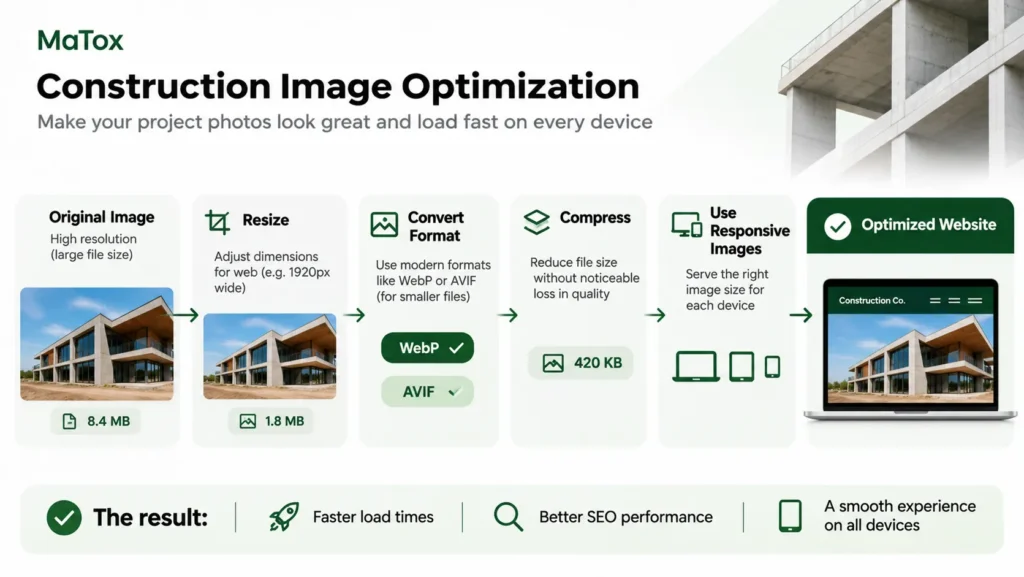
High-quality photography is important for construction companies, so I wouldn’t sacrifice image quality just to improve a performance score. Instead, I would optimize how those images are delivered.
Focus on:
- resizing images to the dimensions they actually need;
- using WebP or AVIF where appropriate;
- compressing images before or during upload;
- serving responsive image sizes;
- lazy-loading images below the fold;
- avoiding unnecessarily large original files.
This lets you showcase the work without forcing every visitor to download oversized project photography.
Fix Technical SEO Problems
Beyond performance, check that Google can properly crawl, index, and understand the website. Important areas include XML sitemaps, indexing, canonical URLs, redirects, broken links and 404s, HTTPS, mobile usability, heading structure, and Core Web Vitals.
I would fix these foundation issues before assuming that publishing more content is the solution.
Don’t Assume Your Page Builder Is the Problem
I also wouldn’t automatically blame WordPress, Elementor, or another page builder when a website is slow. Performance problems can come from oversized images, unnecessary plugins, excessive scripts, poor hosting, animations, sliders, video backgrounds, or incorrect caching.
Before rebuilding the entire website, find out what is actually causing the problem first. Sometimes optimizing the existing setup is a much better decision than replacing it.
Use Reviews to Build Trust and Strengthen Local Visibility
For construction companies, reviews aren’t something I would treat as an afterthought. Before someone requests a quote, they’re often comparing several companies, and real feedback from previous clients can provide the trust that the website alone can’t create.
From my experience working with local businesses, reviews are one of the trust signals I pay the most attention to, especially when local SEO is part of the strategy.
I would focus on:
- consistently asking real clients for Google reviews;
- responding to both positive and negative feedback professionally;
- displaying relevant testimonials on service and project pages;
- using project-specific testimonials when possible;
- keeping reviews genuine rather than trying to collect a large number all at once.
A detailed review that mentions the type of project, service provided, or experience working with the company can also be more useful to a potential client than a generic five-star rating with no context.
But reviews shouldn’t carry the entire trust strategy. I like combining them with completed projects, real photos, years of experience, company information, and clear evidence of the work you’ve actually done.
That combination helps someone arriving from Google answer a much more important question than “Does this company rank?”:
Can I trust this company with my project?
Build Trust With Real Construction Experience and Proof
Reviews are important, but I wouldn’t rely on testimonials alone to prove that a construction company is experienced. The website itself should make that experience visible.
Potential clients should be able to see who you are, what kind of work you’ve completed, how long you’ve been doing it, and whether you have experience with projects similar to theirs.
Useful trust signals can include:
- years of construction experience;
- detailed completed projects and case studies;
- real project and team photography;
- licenses, certifications, and insurance information where applicable;
- professional associations or memberships;
- client testimonials and reviews;
- clearly defined service areas;
- an informative About page;
- consistent business and contact information.
I prefer showing this evidence naturally throughout the website instead of creating one section filled with badges and claims like “trusted,” “experienced,” or “industry-leading.”
For example, if you say your company has extensive commercial renovation experience, link to the commercial renovation projects that demonstrate it. If you’ve been operating for 20 years, explain that history on the About page rather than simply placing “20+ years of experience” in the hero.
The same principle applies to SEO: don’t just tell Google and potential clients that you’re credible. Build a website that gives them enough real evidence to reach that conclusion themselves.
Create Content Potential Construction Clients Actually Search For
I wouldn’t publish construction blog posts simply to keep the website “active.” Every article should answer a question that a potential client could realistically search before or during a project.
Useful topics often include:
- construction and renovation costs;
- project timelines;
- permits and planning requirements;
- material comparisons;
- construction processes;
- common project problems;
- comparisons between different construction options;
- what to expect before starting a project;
- local construction considerations.
The more specific the topic is to the company’s actual services, the better.
For example, “5 Construction Trends to Watch This Year” might generate some traffic, but someone searching “how much does a commercial office renovation cost?” is much closer to a real project decision.
That’s the type of content I would prioritize.
I’d also connect every useful article to the rest of the website. A guide about commercial renovation costs should naturally link to the commercial renovation service page and relevant completed projects. This gives readers somewhere useful to go next while strengthening the internal relationship between your informational and commercial pages.
The goal isn’t to publish the most construction content. It’s to answer the right questions and create a natural path from research to your services.
Build Backlinks and Local Authority
Backlinks can strengthen a construction website’s authority, but I wouldn’t approach link building by buying large packages of generic links or submitting the company to hundreds of random directories.
For construction companies, I prefer looking for links that make sense because of the business, its projects, and the relationships it already has.
Good opportunities can come from:
- local chambers of commerce and business organizations;
- construction and industry associations;
- suppliers and manufacturers you work with;
- architects, designers, engineers, and other project partners;
- relevant local business directories;
- sponsorships and community involvement;
- industry publications;
- noteworthy projects that can earn local media coverage.
Completed projects can create opportunities too. A distinctive commercial development, restoration, community project, or unusual build may have a genuine story behind it that is worth covering or referencing.
I would rather earn a few relevant links from organizations, partners, or publications connected to the construction industry or local market than collect dozens of unrelated backlinks purely to increase a metric in an SEO tool.
The same applies to local authority. Your Google Business Profile, local projects, reviews, business mentions, partnerships, and relevant backlinks should collectively reinforce that your company is a real construction business with genuine experience in the market it serves.
Connect Services, Locations, Projects and Content With Internal Links
Internal links help search engines understand how your pages relate to each other, but they’re also useful for guiding potential clients through the website.
I wouldn’t add internal links simply to hit a certain number. I would build them around the relationships that already exist between your services, locations, projects, and useful content.
For example:
- Blog article → Service page: a guide about commercial renovation costs links to your commercial renovation service.
- Project page → Service page: a completed office renovation links to the service used for that project.
- Project page → Location page: a Dallas project supports your Dallas service-area page.
- Location page → Service pages: visitors can easily see which services you provide in that area.
- Service page → Project pages: claims about your experience are supported by relevant completed work.
This creates what I think of as a connected SEO structure rather than a collection of isolated pages.
I also prefer descriptive anchor text where it makes sense. “See our commercial construction projects” gives both the visitor and search engine more context than repeatedly using vague links such as “learn more.”
The strongest internal links should feel obvious to the person reading the page. If someone wants more information after reading a section, the next relevant page should already be there for them.
Turn Construction SEO Traffic Into Qualified Leads
Ranking higher is useful only if the people arriving on your website can quickly understand what you do, trust your work, and take the next step.
For construction websites, I would keep the conversion path simple. Someone shouldn’t have to search through several pages just to figure out whether you work in their area or how to request a quote.
Make sure important pages include:
- a clear phone number and contact option;
- a visible Request a Quote or project enquiry CTA;
- short forms that don’t ask for unnecessary information;
- the services and areas you cover;
- relevant completed projects;
- reviews and testimonials;
- trust signals such as experience, credentials, and real project photos;
- easy-to-use mobile navigation and CTAs.
I also prefer making the CTA match the page. Someone reading a commercial construction service page could be invited to Discuss Your Commercial Project, while someone viewing a completed renovation could be encouraged to Request a Quote for a Similar Project.
That small amount of context is better than putting the same “Contact Us” button everywhere.
Most importantly, don’t judge construction SEO solely by sessions or keyword rankings. A page attracting 100 highly relevant visitors and generating qualified project enquiries can be more valuable than one attracting 5,000 visitors who were never likely to become clients.
The goal is not more traffic for the sake of traffic. It is more of the right potential clients reaching the right pages and taking action.
Measure Construction SEO Results That Actually Matter
I wouldn’t measure the success of construction SEO by rankings alone. Rankings, impressions, and traffic tell you whether visibility is improving, but they don’t tell you whether that visibility is bringing the company better business opportunities.
I would track SEO metrics such as:
- organic impressions and clicks;
- rankings for important service and local searches;
- organic website traffic;
- Google Business Profile visibility and interactions;
- which service, location, and project pages attract organic visitors.
But I would connect those numbers to actual business outcomes:
- phone calls;
- quote requests;
- contact form submissions;
- qualified leads;
- the service or project type requested;
- where the lead is located;
- booked consultations or projects.
This distinction matters because not every ranking has the same business value.
If an informational article generates thousands of visits but no relevant enquiries, while a commercial construction service page brings 100 visitors and several qualified project requests, I would consider the service page far more valuable to the SEO strategy.
That’s why I prefer measuring construction SEO from search visibility → qualified traffic → enquiries → real project opportunities, rather than celebrating traffic growth on its own.
What I Would Fix First on an Underperforming Construction Website
If I were working with a construction company that had an outdated website and poor organic visibility, I wouldn’t start by publishing more blog posts or building backlinks.
I would start with these three areas:
1. Website Structure and Layout
First, I’d check whether the website clearly separates its services, locations, and completed projects. Potential clients should be able to understand what the company does and find relevant proof of its work without digging through the site.
2. Google Business Profile and Local Visibility
Next, I’d check the Google Business Profile, categories, service areas, reviews, photos, business information, and how well the website supports the locations the company actually serves.
3. Keyword and Page Structure
Finally, I’d map the important searches to the correct pages. Each major service and search intent should have a clear destination instead of several pages competing for the same keyword.
Those three areas would be my starting point before chasing more content or backlinks. Once the foundation is right, it becomes much easier to decide what the construction company actually needs next.
A 90-Day SEO Plan for Construction Companies
If I were starting construction SEO from scratch, I’d prioritize the work instead of trying to fix the website, publish content, build links, and improve local SEO all at once.
Days 1–30: Fix the Foundation
Start with the issues that affect everything else:
- audit the website structure and technical SEO;
- research and map keywords to existing pages;
- optimize the Google Business Profile;
- fix indexing, broken links, redirects, and major performance issues;
- identify missing service and location pages;
- improve the most important existing pages first.
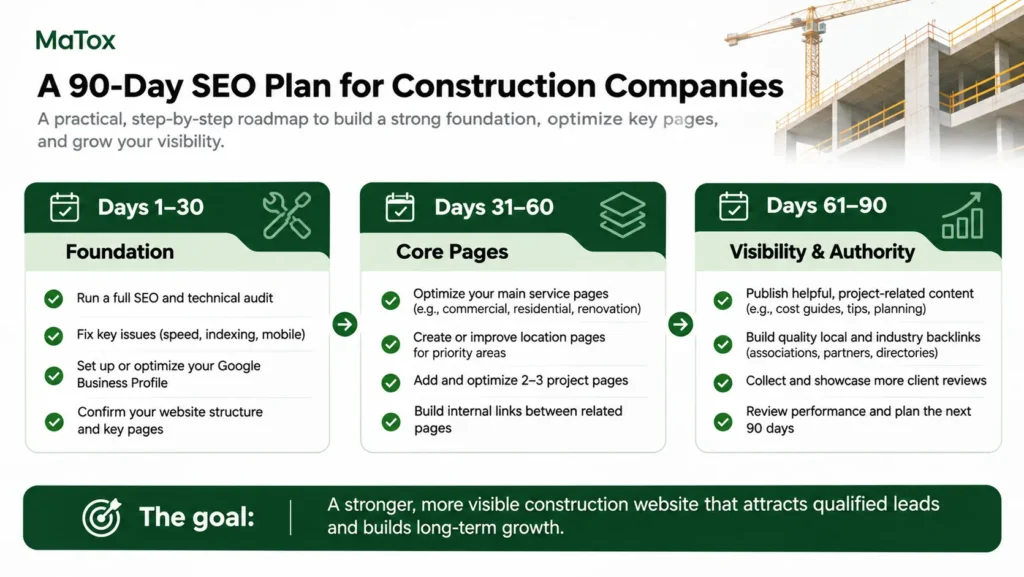
Days 31–60: Build and Optimize Core Pages
Once the foundation is solid:
- create or improve individual service pages;
- build useful location pages where there is genuine local relevance;
- turn strong completed projects into detailed project pages;
- improve titles, headings, internal links, and on-page SEO;
- add reviews, project proof, and stronger conversion points.
Days 61–90: Grow Visibility and Authority
Then start expanding what already works:
- publish content around real client questions;
- strengthen internal links between services, projects, locations, and articles;
- continue collecting genuine reviews;
- pursue relevant local and industry backlinks;
- monitor rankings, organic leads, and Google Business Profile performance;
- use the data to decide what deserves attention next.
I wouldn’t expect every construction company to follow exactly the same timeline. The 90 days are a prioritization framework, not a promise that SEO results will appear within a specific number of days.
The important part is the order: fix the foundation first, build the pages that can generate business second, then invest more heavily in content and authority.
Common Construction SEO Mistakes to Avoid
A lot of construction SEO problems come from doing more rather than doing the right things. I would fix the fundamentals before adding dozens of new pages or publishing more content.
Some of the most common mistakes I would avoid are:
- Using one page for every service. Important services usually need their own focused pages.
- Publishing project galleries with no context. Add the project type, location, scope, services provided, and other useful details alongside the photos.
- Uploading huge project images. Construction websites need strong photography, but the files still need proper sizing and optimization.
- Creating dozens of duplicate city pages. Changing only the location name doesn’t make a page genuinely useful.
- Ignoring Google Business Profile. For locally focused construction companies, the website and GBP should support each other.
- Targeting the same keyword with several pages. Decide which page should own each important search intent.
- Publishing generic AI content at scale. Ten articles that repeat information already available everywhere aren’t necessarily better than one genuinely useful guide based on your services and experience.
- Forgetting internal links. Services, projects, locations, and articles shouldn’t exist as isolated sections of the website.
- Hiding reviews and project proof. Put evidence of your work where potential clients actually need it.
- Focusing on traffic instead of qualified leads. More visitors don’t automatically mean better SEO results.
- Changing URLs without redirects. When redesigning or restructuring a construction website, preserve valuable existing URLs where possible and redirect changed URLs correctly.
- Neglecting mobile usability. Potential clients may discover and evaluate your company from their phone, so navigation, forms, project galleries, and CTAs need to work properly on smaller screens.
The mistake I would avoid most is using SEO tactics simply because they’re on a checklist. Every service page, location page, article, internal link, and optimization should have a clear reason for being there.
SEO for Construction Companies: FAQs
What is SEO for construction companies?
SEO for construction companies is the process of improving a construction company’s website and local search presence so potential clients can find it when searching for relevant services. It typically includes keyword research, service and location pages, Google Business Profile optimization, project content, reviews, technical SEO, internal linking, content, and backlinks.
Does SEO work for construction companies?
Yes, SEO can work particularly well when people already search online for the services a construction company provides. The key is targeting relevant service and local searches, rather than simply trying to generate as much website traffic as possible.
For me, the better measure of whether SEO is working is whether organic search is producing qualified calls, quote requests, and project enquiries.
How long does SEO take for a construction company?
There isn’t one reliable timeline that applies to every construction website. Results depend on factors such as the website’s current condition, competition, location, existing authority, technical problems, content, backlinks, and how much SEO work has already been done.
I would be cautious of anyone promising a specific ranking within a fixed number of weeks or months. Instead, track whether visibility, important rankings, qualified organic traffic, and enquiries are moving in the right direction over time.
How much does SEO for a construction company cost?
The cost depends on what the company actually needs. A construction business needing technical fixes, new service and location pages, local SEO, content, and ongoing authority building requires a very different scope from a company that already has a strong website and only needs targeted optimization.
Rather than choosing SEO based only on the lowest monthly price, I would look at what work is actually included and whether it supports the searches and services capable of generating projects.
Is SEO or Google Ads better for construction companies?
Neither is automatically better.
Google Ads can provide visibility quickly for selected searches, while SEO is focused on building organic visibility across your website and local presence over time. For some construction companies, using both makes sense.
If I had to decide where to invest, I would look at the company’s market, competition, services, budget, existing website, and how quickly it needs to generate opportunities rather than treating SEO and paid search as interchangeable strategies.
Final Thoughts: Building an SEO Strategy That Generates Construction Leads
SEO for construction companies works best when all the pieces support each other. Your keyword strategy determines which pages you need, your service and location pages target the right searches, your projects provide proof, local SEO strengthens your visibility, and technical SEO makes sure the website performs properly.
But I wouldn’t try to implement every SEO tactic at once.
Start by making sure your website has a clear structure, your most important services have dedicated pages, your Google Business Profile is properly optimized, and your completed projects actually demonstrate the work you do. From there, strengthen the strategy with useful content, internal links, reviews, relevant backlinks, and ongoing optimization.
Most importantly, keep the business goal in mind. The best construction SEO strategy isn’t the one that generates the most traffic. It’s the one that helps more of the right potential clients find your company, trust your work, and enquire about a project.
Ready to Improve Your Construction Company’s Online Visibility?
If you need help improving your website, local SEO, or overall search strategy, MaTox Digital Agency can help you build a stronger online presence designed to turn search visibility into qualified leads.

About the Author
Makedonka Tochevska
Makedonka Tochevska is a web designer and front-end developer at MaTox Digital Agency. She works on website design and redesign projects with a focus on WordPress development, user experience, website performance, and SEO implementation.
Her work includes planning and building business websites, construction and architecture websites, improving existing websites, and handling the technical and SEO details that need to be considered when a website changes.