

Med Spa SEO: How to Rank Higher and Get More Bookings
By Makedonka Tochevska · Last Edited October 2026
Med spa SEO is about making sure your business appears when potential clients search for the treatments you offer, the concerns they want to address, or a med spa in their area. But ranking higher is only part of the goal. The right people need to land on the right pages, find the information and trust signals they need, and have a clear path to booking.
Having worked on med spa and aesthetics websites, I’ve found that one of the biggest mistakes is building and optimizing the website around how the business thinks about its services rather than how potential clients actually search. A med spa may focus on a particular device or technology, while someone searching Google is thinking, “treatment for acne scars,” “skin tightening near me,” or “Botox near me.”
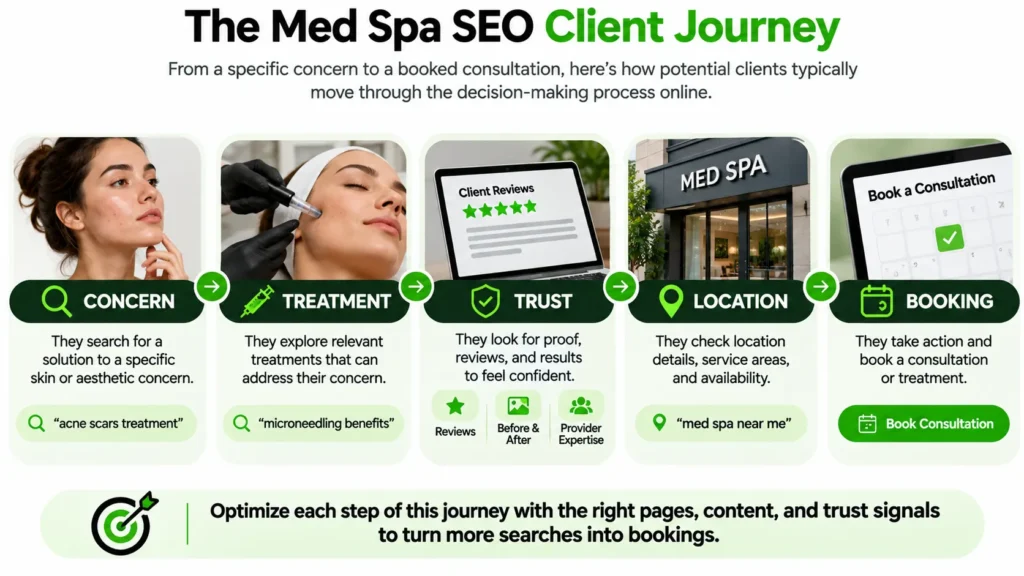
That’s why this guide takes a practical approach to SEO for med spas. We’ll connect keyword strategy, treatment and concern pages, website structure, local SEO, reviews, before-and-after results, performance, content, and booking UX into one strategy built around the actual client journey:
Concern → Treatment → Trust → Location → Booking
TL;DR: SEO for Med Spas
- Med spa SEO should follow how potential clients search, not just how the business organizes or describes its treatments internally.
- Important treatments usually benefit from dedicated, useful pages that can target treatment-specific search intent rather than being grouped together on one thin services page.
- Concern pages can capture people who know what they want to address, such as acne scars, pigmentation, or fine lines, but don’t yet know which treatment they need.
- Local SEO and Google Business Profile optimization should work alongside treatment and location pages, especially for searches that include a city or “near me” intent.
- Reviews, real before-and-after results, accurate treatment information, and clear provider/business information help establish the trust people need before booking.
- Image-heavy med spa websites need strong performance. Properly sized images, WebP files, mobile usability, and a solid technical SEO foundation all matter.
- Rankings and traffic aren’t the final goal. A strong strategy connects Concern → Treatment → Trust → Location → Booking and measures whether organic visibility leads to meaningful inquiries and bookings.
TABLE OF CONTENTS
- What Is Med Spa SEO?
- Why SEO Matters for Med Spas
- How Potential Med Spa Clients Search
- Med Spa SEO Keyword Research
- Map Keywords to the Right Pages
- Build the Right Website Structure
- Create Individual Treatment Pages
- Create Concern Pages
- Local SEO for Med Spas
- Multi-Location Med Spa SEO
- Reviews and Before-and-After Results
- Build Trust With Accurate Information
- On-Page SEO for Med Spas
- Website Speed and Technical SEO
- Med Spa SEO Content
- Backlinks and Local Authority
- Internal Linking
- Turn SEO Traffic Into Bookings
- Measure Med Spa SEO Results
- What I Would Fix First
- Common Med Spa SEO Mistakes
- 90-Day Med Spa SEO Plan
- Med Spa SEO FAQs
- Final Thoughts
What Is Med Spa SEO?
Med spa SEO is the process of improving a medical spa’s visibility in search engines for the treatments, concerns, questions, and local searches potential clients use when looking for aesthetic services.
It combines several parts of search optimization: keyword research, treatment and concern pages, on-page SEO, local SEO, Google Business Profile optimization, technical SEO, content, internal linking, and authority building.
But effective medical spa SEO is not simply about getting a homepage to rank for “med spa + city.”
Different searches need different destinations. Someone searching for “Botox near me” may need a Botox treatment page, while someone searching for “treatment for acne scars” may be better served by a concern page that explains relevant options. Someone asking “Botox vs Dysport” has a different intent again and may need an educational article.
The goal is to connect each important search intent with the most useful page on the website:
Search intent → Relevant page → Trust → Booking
That distinction matters because a med spa can technically rank for keywords and still attract the wrong traffic or make it difficult for potential clients to find the information they need. Good SEO for medical spas focuses on visibility and what happens after someone arrives on the website.
Why SEO Matters for Med Spas
SEO matters for med spas because potential clients often turn to search engines at multiple stages of their decision process. They may search for a specific treatment, research a concern they want to address, compare different procedures, or simply look for a reputable med spa nearby.
That creates opportunities beyond ranking for a broad term like “med spa near me.” A med spa can be discovered through treatment searches such as “Botox near me,” concern-based searches such as “treatment for acne scars,” and informational searches such as “Botox vs Dysport.”
The advantage of SEO is that these searches can connect potential clients with the business while they are already looking for information, treatment options, or a provider.
However, visibility alone isn’t enough. The website still needs to answer the searcher’s question, establish trust, make the location and available treatments clear, and provide an obvious next step.
This is why I don’t think of med spa SEO as a collection of isolated tactics. The website, keyword strategy, Google Business Profile, treatment pages, reviews, local presence, and booking experience need to support each other.
The goal isn’t simply more organic traffic. It’s getting the right potential clients to the right pages and giving them a clear path toward becoming an inquiry or booking.
Understand How Potential Med Spa Clients Actually Search
One of the most important parts of med spa SEO is understanding that potential clients don’t always search using the same language the business uses internally.
A med spa may organize its services around specific devices, technologies, or treatment categories. The person searching Google, however, may only know what they want to improve. Someone concerned about acne scars, pigmentation, fine lines, or hair loss may start with the problem rather than the name of a treatment.
From my experience working on med spa websites, this is one of the biggest mistakes businesses can make: optimizing the website for themselves instead of their audience. Keyword strategy should connect what the med spa offers with the language potential clients actually use when searching.
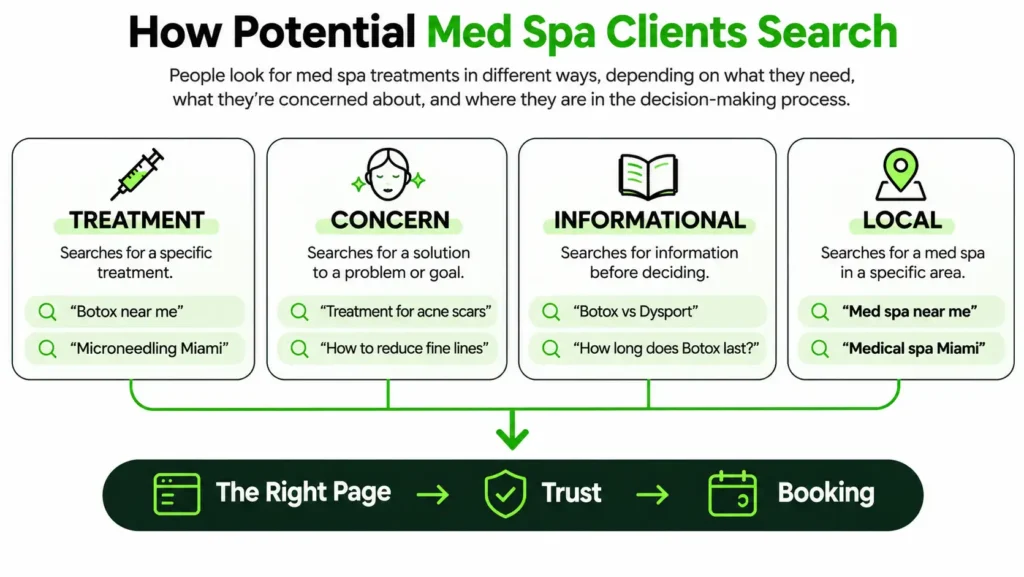
Those searches generally fall into several different types.
Treatment Searches
These come from people who already know the treatment they’re interested in, such as:
- Botox near me
- laser hair removal Miami
- HydraFacial in Miami
- microneedling near me
These searches often have strong local and treatment intent, which is why important treatments should have clear, dedicated destinations on the website.
Concern-Based Searches
Other potential clients know their concern but don’t necessarily know which treatment is appropriate.
They might search for:
- treatment for acne scars
- options for fine lines and wrinkles
- skin pigmentation treatments
- hair loss treatments
This is where concern-focused content can bridge the gap between what someone wants to address and the treatments the med spa offers, without diagnosing the user or making unsupported treatment claims.
Informational Searches
Potential clients also research before they’re ready to book. Searches might include:
- how long does Botox last
- Botox vs Dysport
- what to expect after microneedling
- how to prepare for laser hair removal
These searches can be useful topics for educational content that answers the question and naturally connects readers with relevant treatment pages.
Local and Provider Searches
Finally, some searches are specifically about where to go or who to trust, such as:
- med spa near me
- med spa in Miami
- Botox provider near me
- medical spa in Miami
This is where the website and local SEO strategy need to work together. Location pages, treatment pages, Google Business Profile information, reviews, and accurate business details all help search engines and potential clients understand what you offer, where you offer it, and who is behind the business.
The important takeaway is that these searches shouldn’t all lead to the same page. Each represents a different intent, which brings us to the next part of the strategy: identifying the right keywords and deciding which pages should target them.
Start With Med Spa SEO Keyword Research
Med spa keyword research should identify how potential clients search at different stages of their journey, not simply produce a list of high-volume keywords.
When I work on med spa websites, I look at several types of searches: treatment keywords, treatment + location combinations, concern-based searches, local intent, and longer informational questions. Each serves a different purpose, and eventually each needs to be connected to the right page.
Treatment Keywords
Start with the treatments the med spa actually offers. Depending on the business, these could include searches around:
- Botox
- dermal fillers
- laser hair removal
- HydraFacial
- microneedling
- chemical peels
Don’t stop at the broad treatment name. Look at variations that reveal what the searcher actually wants and make sure the terminology matches the services the med spa genuinely provides.
Local Keywords
For a local business, treatment keywords often become more valuable when combined with location intent:
- Botox Miami
- laser hair removal Miami
- HydraFacial near me
- med spa in Miami
The goal isn’t to insert the city into every paragraph. It’s to understand which searches have local intent and make sure the appropriate treatment, homepage, or location page can satisfy it.
For multi-location med spas, this becomes even more important because the keyword strategy needs to reflect which treatments are available at which locations.
| Keyword Type | Example Search | Search Intent | Best Page Type |
|---|---|---|---|
| Treatment | Botox | Find a specific treatment | Treatment page |
| Treatment + Local | Botox Miami | Find a treatment nearby | Treatment or location page |
| Concern | Acne scar treatment | Find a solution to a concern | Concern page |
| Informational | How long does Botox last? | Research before deciding | Blog article or FAQ |
| Comparison | Botox vs Dysport | Compare treatment options | Comparison article |
| General Local | Med spa Miami | Find a local med spa | Homepage or location page |
Concern-Based Keywords
Potential clients may search for a concern before they know the name of a treatment.
Examples include:
- acne scar treatment
- treatment for fine lines
- hyperpigmentation treatment
- hair loss treatment
These keywords can reveal opportunities that treatment-only research misses. They can also help determine whether a dedicated concern page makes sense and which relevant treatments should be connected to it.
Informational and Long-Tail Keywords
Research questions potential clients ask before making a decision, such as:
- how long does Botox last
- Botox vs Dysport
- what to expect after microneedling
- how to prepare for laser hair removal
These aren’t necessarily keywords for your main treatment pages. Many are better suited to articles, FAQs, or supporting educational content.
The important part comes after collecting the keywords. Don’t create a new page for every variation you find. Group keywords by search intent and decide which existing or future page should own each topic.
That prevents several pages from unnecessarily competing for the same searches and creates a much clearer SEO structure.
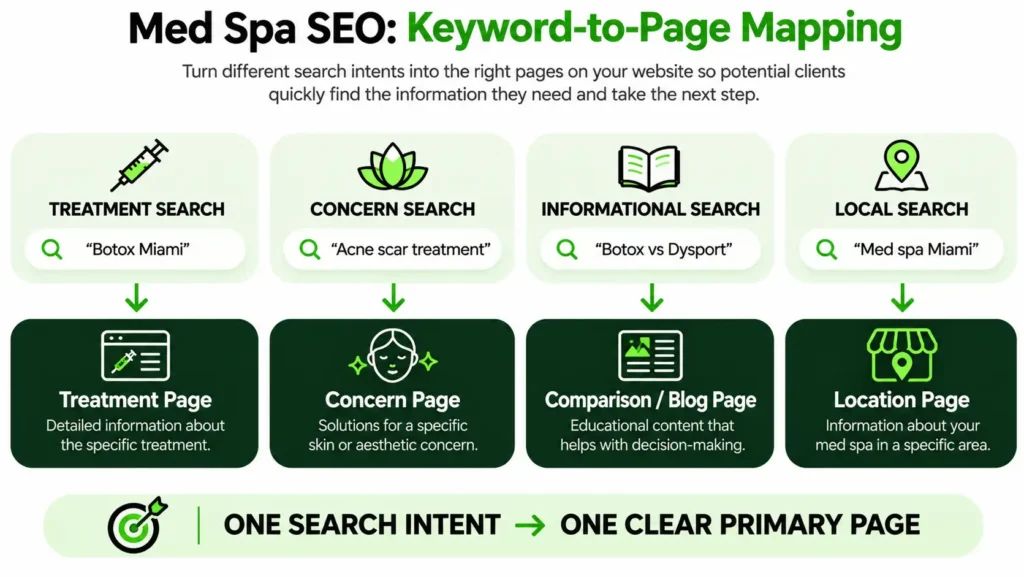
One search intent → one clear primary page.
Map Med Spa Keywords to the Right Pages
Finding the right keywords is only half the job. The next step is deciding which page on the website should target each search intent.
A common mistake is trying to make the homepage rank for everything: the med spa itself, every treatment, every concern, and every location. Another is creating several pages that target slightly different versions of essentially the same search, which can leave multiple pages competing for the same intent.
A better approach is to give each important search intent a clear primary destination.
For example, someone searching “med spa Miami” is looking for the business or a local provider, while someone searching “Botox Miami” has already narrowed their search to a particular treatment. Those searches don’t necessarily deserve the same landing page.
The same applies to concern and informational searches. Someone searching “acne scar treatment” may not know which treatment is appropriate yet, while someone asking “how long does Botox last?” is looking for information rather than immediately searching for a provider.
A practical keyword-to-page map might look like this:
| Search | Search Intent | Primary Page |
|---|---|---|
| med spa Miami | Find a local med spa | Homepage or Miami location page |
| Botox Miami | Find a specific treatment locally | Botox treatment page |
| acne scar treatment | Explore options for a concern | Acne Scars concern page |
| Botox vs Dysport | Compare treatments | Comparison article |
| how long does Botox last? | Research a treatment | Educational article or relevant FAQ |
| Dream Body Medspa | Find a specific business | Homepage |
The principle I use is simple:
One search intent → one clear primary page.
That doesn’t mean a keyword can only appear on one page. Related pages will naturally mention the same treatments, concerns, and locations. The difference is that one page should be the strongest and clearest destination for the primary intent.
Once that ownership is established, internal links can connect the supporting pages instead of making them compete. An article about acne scars can point to an Acne Scars concern page, which can connect to relevant treatment pages, results, the appropriate location, and ultimately the booking path.
This keyword-to-page mapping also makes the next decision much easier: how the entire med spa website should be structured.
Build the Right Med Spa Website Structure
A strong med spa website structure should make it easy for both potential clients and search engines to understand what you offer, what concerns you address, where you’re located, who provides the services, and where someone can see results or book.
Instead of relying on a homepage and one large services page, the site can be organized around the different types of search intent we mapped above.
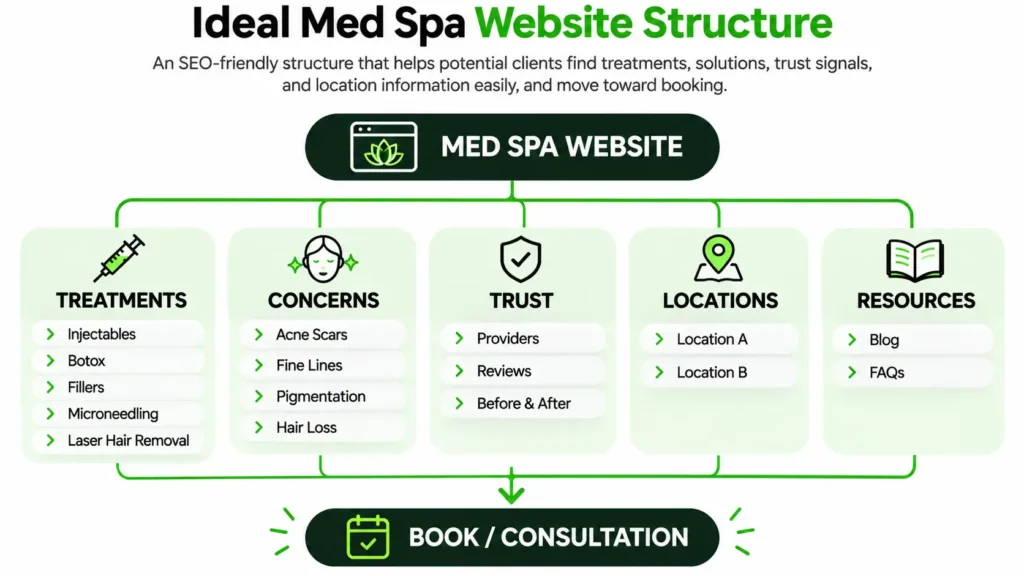
A practical structure might look like this:
Home
Treatments
- Injectables
- Botox
- Dermal Fillers
- Skin
- HydraFacial
- Microneedling
- Chemical Peels
- Laser
- Laser Hair Removal
- Skin Resurfacing
Concerns
- Acne Scars
- Fine Lines & Wrinkles
- Hyperpigmentation
- Hair Loss
Providers
Before & After / Results
Locations
- Individual location pages where needed
About
Blog / Resources
Book
Each section has a different job. Treatment pages explain what the med spa offers. Concern pages connect potential clients’ problems with relevant options. Location pages establish where services are available. Provider pages help establish who is behind the treatments. Results and reviews provide proof and trust, while educational content answers questions people have before they’re ready to book.
What Pages Should a Med Spa Website Have?
There isn’t one universal page count that every med spa needs. The structure should reflect the treatments, locations, providers, and search demand that actually exist.
From my experience, both grouped service structures and individual treatment pages can work. But I prefer giving the most important treatments their own pages when there is enough useful information and search intent to justify them. That creates more room to explain the treatment properly and optimize the page around a specific topic rather than forcing many unrelated services onto one page.
The same rule applies elsewhere. You don’t need a separate concern, provider, or location page simply because it appears in an SEO checklist. A page should have a clear purpose and enough unique value to deserve its own URL.
The goal is a structure where someone can naturally move through the site based on what they need:
Concern → Treatment → Results/Trust → Location → Booking
That structure also creates logical relationships between pages, which we can reinforce later through internal linking.
Create Individual Pages for Your Most Important Treatments
Important treatments usually deserve more than a short paragraph on a general services page. A dedicated treatment page gives you space to match treatment-specific search intent, answer the questions potential clients have, establish trust, and guide them toward the next step.
I’ve worked with both grouped treatment structures and dedicated individual treatment pages on med spa and aesthetics websites. Both can work, but for important treatments, I generally prefer individual pages. They give you more room for treatment-specific information and SEO without trying to make one broad services page rank for many different intents.
That doesn’t mean creating a thin page for every treatment on the menu. A dedicated URL should have enough useful, accurate information to justify its existence.
What a Strong Med Spa Treatment Page Should Include
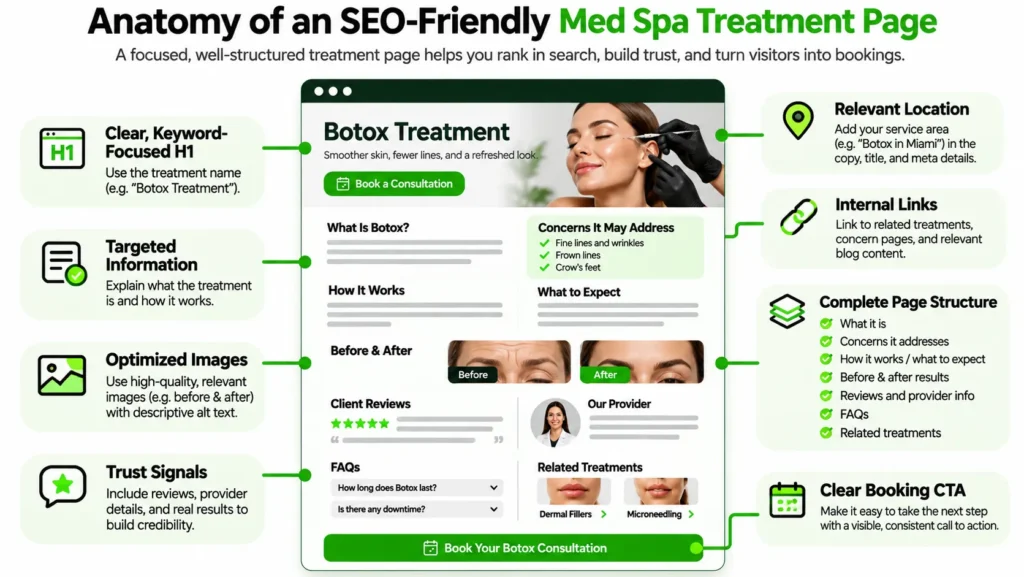
Depending on the treatment, a useful page may include:
- a clear explanation of the treatment
- concerns the treatment may address
- how the treatment works
- treatment areas
- what clients can expect
- downtime or recovery information where applicable
- relevant FAQs
- provider or trust information
- before-and-after examples where appropriate
- relevant reviews or testimonials
- related treatments
- a clear consultation or booking CTA
The clinical information is especially important to handle correctly. When I work on med spa websites, I don’t invent treatment details for SEO purposes. That information comes from the client or is approved by them. My role is to organize, structure, design, and optimize it so potential clients can understand it and search engines can clearly identify what the page is about.
The page should also connect naturally to the rest of the website. For example, a microneedling page might link to an Acne Scars concern page, relevant before-and-after results, the location where the treatment is offered, related educational content, and the correct booking destination.
That turns the treatment page into more than an SEO landing page. It becomes an important step in the journey from search → treatment information → trust → booking.
Need help improving your med spa website?
I’ve worked on med spa and aesthetics websites involving treatment-page structure, local SEO, booking integrations, website performance, and on-page optimization. If your current website isn’t structured around how potential clients actually search, MaTox can help you identify what needs to change.
Create Concern Pages Around What Clients Actually Search For
Not every potential client begins their search knowing which treatment they need. Many start with the concern they want to address, such as acne scars, fine lines, pigmentation, or hair loss.
This is why concern pages can be a useful part of a med spa SEO strategy. They create a destination for problem-based searches and help connect someone who knows what they want to improve with the treatments the med spa offers.
For example, an Acne Scars page could explain the concern using accurate, client-approved information and then introduce the relevant treatments available at that particular med spa. From there, visitors can explore individual treatment pages, see relevant results, and decide whether they want to book a consultation.
The important distinction is that a concern page and a treatment page have different jobs:
- Concern page: “This is what I want to address. What are my options?”
- Treatment page: “I’m interested in this treatment. Tell me more about it.”
I’ve found this distinction useful because it reflects how people actually search. A potential client may never search for the name of a particular device or procedure if they don’t yet know it exists. They may simply search for the problem they’re trying to solve.
Concern pages also shouldn’t be created for every possible keyword variation. Build them when there is genuine search intent, a clear relationship to treatments the med spa actually provides, and enough useful information to justify a standalone page.
And because we’re dealing with aesthetic and health-related concerns, these pages need an important boundary: they should help people navigate relevant information, not diagnose them or promise that a particular treatment will produce a specific outcome.
A well-structured concern page should ultimately help create a natural path:
Concern → Relevant Treatments → Results & Trust → Location → Consultation or Booking
Local SEO for Med Spas: Improve Visibility in Your Area
For most med spas, SEO has a strong local component. Potential clients aren’t only researching treatments; they’re often looking for a business that provides those treatments in a specific city or near them.
That’s why local SEO for med spas shouldn’t be treated as something separate from the website. Your Google Business Profile, treatment pages, location pages, reviews, and business information should all reinforce what you offer and where you offer it.
I’ve worked directly with Google Business Profile optimization, location keywords, location pages, NAP consistency, metadata, schema, and reviews for local businesses and med spa websites. One thing I prioritize is making the relationship between the service and the location clear rather than simply adding a city name everywhere.
Optimize Your Google Business Profile
Your Google Business Profile is an important part of your local search presence. Make sure the core information is accurate and complete, including your:
- business name
- address
- phone number
- business hours
- website
- appropriate business categories
- services
- photos
The profile should represent the actual business accurately. Avoid adding keywords to the business name simply to try to improve rankings.
For med spas with multiple locations, each legitimate location should also lead potential clients to the correct information on the website rather than creating a confusing journey between Google, the site, and booking.
Keep Your Business Information Consistent
Your core business details should be accurate and consistent wherever potential clients and search engines encounter them.
This is particularly important for multi-location med spas. Each location needs clearly identifiable contact information, hours, address details, and other relevant location information.
The website should make those distinctions equally clear. Someone who finds the business through local search shouldn’t have to guess which phone number, address, or booking option belongs to their location.
Connect Local SEO With Treatment Pages
Local SEO becomes more useful when it connects with the treatments people are actually searching for.
A query such as “Botox Miami” contains both treatment and local intent. Instead of trying to make a generic location page rank for every treatment imaginable, make sure your treatment and location architecture clearly communicates which services are available and where.
This is also why keyword mapping matters. Depending on the website structure and search intent, the strongest destination for a local treatment search may be a treatment page, a location-specific treatment experience, or a relevant location page.
The goal is not to create dozens of nearly identical pages with city names swapped out. It’s to build a local search presence where Google and potential clients can clearly understand the relationship between your treatments, business, and locations.
Create Strong Location Pages for Multi-Location Med Spas
If a med spa operates in multiple locations, each location should have a clear place within the website structure. A strong location page helps search engines understand where the business operates while giving potential clients the practical information they need before visiting or booking.
I’ve worked with multi-location med spa websites where locations had different business information and different booking links. In that situation, clarity matters. Someone researching a treatment at one location shouldn’t accidentally be sent to the booking flow for another.
A useful location page can include:
- unique information about the location
- correct address, phone number, and business hours
- treatments available at that location
- relevant providers where appropriate
- genuine photos of the location
- relevant reviews or testimonials
- map and directions
- links to important treatment pages
- the correct consultation or booking option for that location
The content should also be genuinely specific to the location. Simply duplicating one page several times and replacing the city name creates little value for potential clients.
For example, if certain treatments or providers are available only at one location, that distinction should be clear. The same applies to contact information, photos, directions, hours, and booking destinations.
This is also where the website architecture and local SEO strategy come together. A location page can establish where the med spa operates, while dedicated treatment pages establish what it offers. Internal links between them help users and search engines understand that relationship.
For a multi-location med spa, the journey should remain straightforward:
Search → Correct Location → Relevant Treatment → Trust → Correct Booking Destination
The goal isn’t to create as many city pages as possible. It’s to create useful location pages for the places where the med spa genuinely operates and make each one valuable enough to deserve its own URL.
Use Reviews and Before-and-After Results to Build Trust
For med spas, visibility gets someone to the website, but trust plays a major role in whether they take the next step. Two of the strongest trust elements I’ve found when working on med spa and aesthetics websites are reviews and real before-and-after results.
These assets shouldn’t be isolated from the rest of the website. They work best when they’re connected to the treatments and decisions they support.
Reviews
Reviews can help potential clients understand what other people experienced with the business before deciding whether to book.
They also support local visibility and reputation, particularly alongside an optimized Google Business Profile. But from a website perspective, don’t limit every testimonial to one generic Reviews page.
Relevant reviews can also appear near important decision points, such as:
- treatment pages
- location pages
- provider sections
- consultation or booking CTAs
The goal isn’t to repeat the same testimonials everywhere. It’s to place relevant proof where someone may need reassurance before taking the next step.
Reviews should always be genuine. Don’t create, rewrite, or exaggerate client experiences simply to make a page appear more convincing.
Before-and-After Results
Before-and-after imagery is particularly valuable on aesthetic websites because potential clients often want to see real examples before considering a treatment.
My preferred structure is to use both treatment-specific results and a dedicated Before & After or Results page.
Relevant examples can appear directly on individual treatment pages, where they’re connected to the service someone is currently researching. A dedicated Results page can then provide a broader place to explore the med spa’s work.
This creates useful connections in both directions:
Treatment → Relevant Results → Booking
and
Results → Relevant Treatment → Booking
Before-and-after images should also be presented with accurate context and any disclosures or approvals required by the business and applicable rules. From the SEO and website side, they should use descriptive image information and be properly optimized so a large gallery doesn’t unnecessarily slow down the site.
Reviews and results aren’t there simply to make the website look more impressive. Their real value is helping connect information with evidence and trust at the points where potential clients are deciding what to do next.
Build Trust With Real Experience and Accurate Treatment Information
Med spa websites sit closer to health-related content than a typical local business website, so accuracy matters. SEO should make treatment information easier to find and understand, not encourage a business to publish medical claims simply because they might attract searches.
When I work on med spa websites, I don’t invent the clinical details of a treatment for SEO purposes. Treatment information comes from the client or is approved by them. My role is to structure, design, and optimize that information so it’s clear, useful, search-friendly, and easy for potential clients to navigate.
That distinction is important.
A strong med spa website should make it clear who the business is, where it operates, what treatments it provides, and who is behind those services. Depending on the business and treatment, useful trust signals may include:
- accurate treatment information
- real business and location information
- provider information and credentials where appropriate
- genuine reviews
- real before-and-after results
- clear contact information
- transparent consultation or booking options
- appropriate sources for health-related claims
Provider pages can be particularly useful when they contain meaningful information rather than just a name and photograph. Relevant education, credentials, professional experience, areas of practice, and the locations where the provider works can help potential clients understand who may be involved in their care.
The same standard should apply to treatment content. Avoid exaggerating outcomes, presenting uncertain information as fact, or adding claims solely because a competitor uses them.
This is also where E-E-A-T should be real rather than decorative. Adding an “expert reviewed” badge means little if the website doesn’t clearly demonstrate who created or approved the clinical information, who provides the treatments, and what real experience supports the business.
For med spa SEO, trust isn’t something to add after the optimization is finished. Accurate information, real people, real results, and a transparent business identity are part of the optimization itself.
Optimize Important Med Spa Pages for On-Page SEO
Once each keyword has a clear page to target, on-page SEO helps search engines and potential clients understand what that page is about and why it is relevant to their search.
For med spa websites, I prefer keeping this straightforward. You don’t need to force the same keyword into every heading or paragraph. The primary topic should be clear, while related treatments, concerns, locations, and terminology appear naturally where they’re useful.
For each important treatment, concern, or location page, pay attention to:
- SEO title: Clearly describe the page’s main topic and include relevant local context when appropriate.
- H1: Give the page one clear primary heading that accurately represents its purpose.
- Headings: Organize information around the questions and details potential clients actually need.
- URL: Keep it descriptive, concise, and easy to understand.
- Meta description: Summarize what the page offers and give searchers a useful reason to visit.
- Internal links: Connect relevant treatments, concerns, locations, results, providers, and educational content.
- Image alt text: Describe meaningful images accurately rather than stuffing keywords into every image.
- FAQs: Answer genuine treatment or decision-making questions when they add value to the page.
For example, a Botox page doesn’t need to repeat “Botox Miami” in every section to establish relevance. The treatment itself, location context, page title, headings, supporting content, internal links, provider information, and related entities can collectively make the topic clear.
The same principle applies to metadata. Write titles and descriptions for people first, while making the subject of the page unambiguous to search engines.
On-page optimization works best after the website architecture and keyword mapping are already established. Otherwise, you can end up perfectly optimizing several pages for the same intent, which doesn’t solve the underlying problem.
The objective is simple: each important page should have a clear topic, clear purpose, and clear relationship to the rest of the med spa website.
Improve Med Spa Website Speed and Technical SEO
A med spa website can have strong treatment content and local optimization, but technical problems can still make it harder for search engines to crawl the site and frustrating for potential clients to use it.
This is especially relevant for med spa websites because they tend to be visual. Treatment imagery, before-and-after galleries, videos, sliders, and other media can quickly make pages unnecessarily heavy if they’re not handled properly.
Optimize Treatment and Before-and-After Images
One of my practical rules when building and optimizing image-heavy websites is simple: use the correct image dimensions and an efficient format such as WebP.
Uploading a huge image and displaying it at a fraction of its original size wastes resources. Before-and-after galleries can multiply that problem when a page contains many images.
For important images:
- resize them for their actual display needs
- use WebP or another appropriate modern format
- compress files without visibly damaging quality
- use descriptive filenames
- write useful alt text when the image needs one
- avoid loading unnecessarily large images on mobile
- lazy-load images that don’t need to appear immediately
The objective isn’t to sacrifice the visual quality that’s important for an aesthetics business. It’s to deliver those visuals efficiently.
Make the Website Work Well on Mobile
Potential clients need to be able to research treatments, browse results, read reviews, find a location, and book comfortably from a phone.
Pay particular attention to:
- navigation
- treatment-page readability
- before-and-after galleries
- buttons and booking CTAs
- forms
- phone links
- location information
- page speed
A booking button that technically exists but is difficult to find or use on a small screen still creates unnecessary friction.
Check the Technical SEO Foundation
Beyond performance, the website needs a clean technical foundation so search engines can access and understand its important pages.
Check areas such as:
- crawlability and indexability
- XML sitemap
- canonical URLs
- HTTPS
- broken links and redirects
- duplicate or unnecessary pages
- Core Web Vitals and page performance
- mobile usability
- appropriate structured data/schema
Technical SEO doesn’t need to become the centerpiece of the med spa’s strategy, but it supports everything else we’ve discussed. There is little value in creating excellent treatment, concern, and location pages if search engines struggle to crawl them or potential clients leave because the website performs poorly.
Create Med Spa Content Potential Clients Actually Search For
A med spa blog shouldn’t exist just because someone said publishing regularly is good for SEO. Content should target real questions potential clients ask before choosing a treatment or deciding whether to book.
This is where the informational and long-tail keywords from your research become useful. Instead of trying to force every question onto a treatment page, create supporting content for searches such as:
- how long does Botox last?
- Botox vs Dysport
- how to prepare for laser hair removal
- what to expect after microneedling
- questions about specific concerns and available treatment options
These articles can capture people earlier in their research and then guide them toward the appropriate treatment, concern, provider, results, or location page.
For example:
“Botox vs Dysport” article → Botox treatment page → Results → Location → Booking
This is much more useful than publishing disconnected blog posts that generate impressions but have no relationship to the med spa’s actual services.
How Often Should a Medical Spa Publish Blog Content?
There isn’t a universal number of blog posts a med spa needs to publish each month.
I would prioritize useful coverage over an arbitrary publishing schedule. If the website still has thin treatment pages, missing location information, or no useful content around important concerns, those foundational pages may deserve attention before publishing several new blog posts every month.
Once the foundation is strong, use keyword and search-intent research to identify questions that genuinely support the treatments the med spa provides. A smaller collection of useful, well-connected resources can be more strategically valuable than publishing content simply to maintain a schedule.
Because treatment content can involve health-related information, accuracy remains important here too. Clinical information should come from or be approved by the med spa or an appropriately qualified professional rather than being invented to target a keyword.
The goal is to build a content library where every useful article has a reason to exist:
Answer the question → connect it to the relevant service → help the reader continue their journey.
Build Backlinks and Local Authority
Backlinks can help strengthen a med spa website’s authority, but the goal shouldn’t be to collect as many links as possible. Relevance, legitimacy, and quality matter more than raw link count.
For a local med spa, useful link opportunities can come from sources that have a genuine connection to the business, its industry, or its location, such as:
- local business organizations
- reputable local directories
- relevant industry associations
- partnerships with other legitimate businesses
- local publications
- PR and editorial mentions
- events or organizations the med spa genuinely participates in
Local relevance can be particularly useful. If a med spa is featured by a legitimate publication or organization in the city where it operates, that link also reinforces the connection between the business and its location.
Avoid treating link building as a shortcut. Buying large quantities of low-quality backlinks, submitting the website to hundreds of questionable directories, or creating irrelevant links simply to increase a metric can create a backlink profile that looks impressive in an SEO tool without building meaningful authority.
Before actively pursuing links, I would also make sure the website itself is worth linking to. Useful treatment resources, original educational content, real results, strong provider information, and genuinely helpful resources give other websites a better reason to reference the business.
For med spa SEO, the better question isn’t “How many backlinks do we need?”
It’s:
“Which legitimate websites would have a real reason to mention or reference this med spa?”
That keeps link building connected to reputation and local authority rather than turning it into a numbers game.
Connect Treatments, Concerns, Results, Locations and Content With Internal Links
Internal links help search engines understand how the pages on a med spa website relate to each other, but they’re equally important for helping potential clients move naturally through their research.
Instead of treating treatment pages, concern pages, results, locations, and blog content as separate parts of the website, connect them around the client journey.
For example:
Acne Scars → Relevant Treatment → Before & After Results → Location → Booking
Or:
“Botox vs Dysport” Article → Botox Treatment → Provider/Results → Location → Booking
This is more useful than adding generic links such as “click here” simply because an SEO checklist says every page needs internal links.
A concern page should link to the treatments that may be relevant to that concern. Treatment pages can link back to related concerns, real results, providers, FAQs, educational articles, and the locations where that treatment is available. Location pages should make it easy to reach the treatments offered there and the correct booking destination.
The anchor text should also help users understand what they’ll find after clicking. Descriptive phrases such as “Botox treatment,” “acne scar treatment options,” or “before-and-after results” provide more context than vague anchors.
Internal linking also helps prevent useful content from becoming isolated. If you publish an article answering a common treatment question but never connect it to the corresponding treatment page, you’re missing an opportunity to move that visitor closer to the next step.
This is why I think about med spa SEO as a connected system rather than a collection of optimized pages:
Concern → Treatment → Trust → Location → Booking
Every internal link should have a purpose within that journey.
Turn Med Spa SEO Traffic Into Bookings
Ranking higher and attracting organic traffic only matters if the website makes it easy for potential clients to take the next step. SEO brings the right person to the page; the website still has to help them move from research to booking.
This is why I don’t separate SEO completely from website UX. Someone landing on a treatment page may still need to see results, read reviews, check the location, understand who provides the treatment, or find answers to common questions before they’re ready to book.
The path should make those next steps obvious.
For important treatment and location pages, consider:
- a clear consultation or booking CTA
- visible phone and contact options where appropriate
- relevant reviews close to decision points
- links to before-and-after results
- provider information when relevant
- clear location information
- treatment FAQs
- booking buttons that work properly on mobile
- the correct booking destination for each location
I’ve integrated booking platforms such as Vagaro and Fresha into aesthetics websites, and the priority is straightforward: the transition from the website to the booking system should be clear and intentional.
This becomes especially important for multi-location med spas. If different locations use different booking links, someone researching a treatment at one location shouldn’t have to figure out which appointment page they need after clicking “Book.”
Don’t measure the success of a page only by whether it ranks.
A treatment page that brings in qualified visitors and consistently guides them toward calls, consultations, forms, or bookings is doing a much more valuable job than a page that generates traffic without a clear next step.
The complete journey should feel connected:
Search → Relevant Page → Information → Trust → Location → Booking
Getting traffic but not enough inquiries or bookings?
MaTox combines SEO with website structure, performance, and conversion-focused design to help turn organic visibility into a clearer path toward becoming a client.
Measure Med Spa SEO Results That Actually Matter
Med spa SEO shouldn’t be measured by rankings alone. Rankings and organic traffic help show whether visibility is improving, but the more important question is: Are the right potential clients finding the website and taking meaningful actions?
A med spa can gain more organic traffic without necessarily gaining more qualified inquiries. That’s why I would look at SEO performance across several stages of the client journey.
Useful metrics to monitor include:
- organic search visibility for important treatments and local searches
- organic traffic to treatment, concern, and location pages
- which treatment pages attract qualified search traffic
- Google Business Profile visibility and interactions
- booking-button clicks from organic visitors
- phone calls and contact-form submissions
- consultation requests
- completed bookings, when tracking allows it
- engagement with important pages such as results, providers, and locations
The key is connecting SEO performance to the pages that actually support the business.
For example, increasing traffic to a blog article can be useful, but I’d want to know what happens afterward. Are readers continuing to a relevant treatment page? Are they viewing results? Are they reaching the booking process?
The same applies to keyword rankings. Moving higher for a broad informational search may look impressive in an SEO report, while improving visibility for a treatment-plus-location search could bring someone much closer to booking.
Tracking also helps reveal where the problem actually is.
If an important treatment page isn’t receiving impressions, the issue may involve keyword targeting, content, authority, or indexation. If it receives relevant organic traffic but very few people continue toward booking, the page itself and the user journey deserve closer attention.
The objective isn’t simply:
More rankings → More traffic
It’s:
More relevant visibility → More qualified visits → More meaningful inquiries and booking opportunities.
That is a much more useful way to judge whether a medical spa SEO strategy is actually supporting growth.
What I Would Fix First on an Underperforming Med Spa Website
If a med spa came to me because its website wasn’t generating enough organic visibility or qualified inquiries, I wouldn’t start by publishing more blog posts or chasing backlinks.
I would look at three things first: the website, the keyword strategy, and the Google Business Profile.
1. The Website
First, I’d look at whether the website actually supports how potential clients search and make decisions.
Are the most important treatments buried inside one general services page? Are there useful individual treatment pages? Can someone researching a concern discover relevant treatment options? Are reviews and before-and-after results easy to find? Is the correct location and booking option obvious?
I’d also check performance, mobile usability, navigation, internal linking, and whether important pages can be properly crawled and indexed.
Before trying to bring significantly more traffic to a website, I want the website to be capable of doing something useful with that traffic.
2. The Keyword Strategy
Next, I’d check what the website is actually targeting.
One of the biggest mistakes I’ve seen with med spa websites is optimizing around how the business describes its services instead of how potential clients search for them.
I would map the important searches across:
Treatments + Locations + Concerns + Questions
Then I’d determine which existing page should target each search intent and where genuinely new pages are needed.
This often reveals gaps that aren’t obvious from looking at rankings alone.
3. The Google Business Profile
For a local med spa, I would also check the Google Business Profile early in the process.
I’d look at whether the business information is accurate, the correct website and location information are connected, services are represented properly, reviews are being earned, and the profile supports what the website is communicating about the business.
These three areas create the foundation:
Website → Keyword Strategy → Google Business Profile
Only after understanding those would I decide whether the next priority should be new treatment pages, concern pages, content, technical fixes, local SEO work, or authority building.
Common Med Spa SEO Mistakes to Avoid
Most med spa SEO problems don’t come from one missing keyword or technical setting. They happen when the website, content, local presence, and client journey aren’t working together.
Here are some of the mistakes I would watch for most closely:
| Mistake | Why It Hurts SEO | Better Approach |
|---|---|---|
| Optimizing for internal terminology | Potential clients may search by concern or desired treatment instead. | Research how clients actually search and map those searches to relevant pages. |
| Putting every treatment on one services page | Important treatments have little room to target their own intent. | Create useful individual pages for priority treatments. |
| Creating thin treatment pages | More pages don't automatically mean better SEO. | Give each important page enough useful, accurate information to justify its existence. |
| Ignoring concern-based searches | You miss people who know their problem but not the treatment. | Create relevant concern pages that connect users with appropriate treatments. |
| Sending everything to the homepage | Different searches require different destinations. | Match each major search intent with one clear primary page. |
| Creating duplicate location pages | Swapping city names creates little unique value. | Build genuinely useful pages for real locations. |
| Ignoring Google Business Profile | Website SEO alone misses an important part of local visibility. | Optimize the website and Google Business Profile as connected parts of local SEO. |
| Using oversized images | Treatment and results galleries can make pages unnecessarily heavy. | Resize, compress, and use formats such as WebP. |
| Publishing blog content without a strategy | Traffic may have little connection to treatments or bookings. | Target useful questions and internally link content into the client journey. |
| Focusing only on rankings | Higher rankings don't automatically produce qualified inquiries. | Track treatment traffic, calls, forms, booking clicks, and other meaningful actions. |
The mistake behind many of these is the same one I’ve mentioned throughout this guide: building the SEO strategy around the med spa rather than around the potential client.
A business may want to promote a specific device, technology, or branded treatment. But the person searching Google may simply be looking for a solution for acne scars, fine lines, unwanted hair, or another concern.
Good med spa SEO connects those two sides.
Instead of asking only, “What do we want to rank for?”, ask:
“What is this person trying to find, which page should answer that search, and what should their next step be?”
That question keeps keyword targeting, website architecture, content, local SEO, trust, and booking UX working toward the same goal.
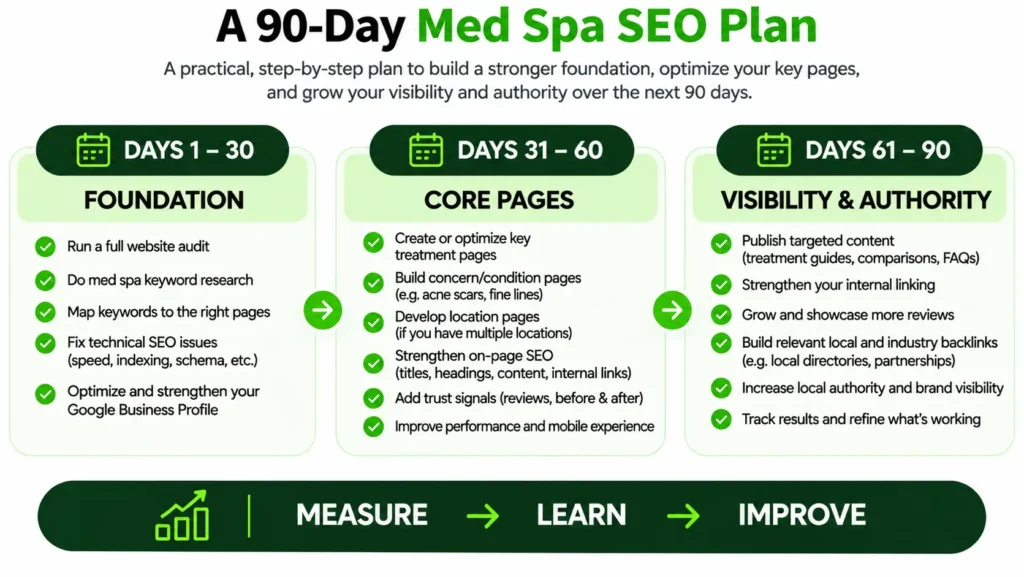
A 90-Day Med Spa SEO Plan
A 90-day med spa SEO plan should focus on building the right foundation first, then improving the pages that matter most, and finally expanding visibility with supporting content and authority.
This isn’t a promise that a med spa will rank within 90 days. SEO timelines vary based on the website’s current condition, competition, location, authority, and many other factors. Think of this as a practical order of operations for the first three months.
Days 1–30: Build the Foundation
The first month should identify what is already working, what is missing, and where the biggest opportunities are.
Focus on:
- auditing the website and existing organic visibility
- researching treatment, concern, local, and informational keywords
- mapping important keywords to the correct pages
- identifying missing or competing pages
- checking crawlability, indexation, sitemap, redirects, and other technical issues
- reviewing website speed and mobile usability
- auditing the Google Business Profile
- checking business and location information for accuracy
- reviewing the path from important pages to booking
By the end of this stage, you should know which searches matter, which pages should target them, and what needs to be fixed first.
Days 31–60: Improve the Core Pages
Next, focus on the pages closest to the med spa’s services and potential bookings.
Priorities may include:
- improving important treatment pages
- creating missing treatment pages where justified
- building useful concern pages
- improving real location pages
- optimizing titles, headings, metadata, and internal links
- adding relevant reviews and before-and-after results
- strengthening provider and trust information
- optimizing images and page performance
- connecting each location with the correct booking destination
This is where the keyword strategy starts becoming an actual website structure rather than a spreadsheet of search terms.
Days 61–90: Expand Visibility and Authority
Once the foundation and core pages are stronger, expand the strategy around them.
This can include:
- creating content around useful treatment questions
- targeting relevant long-tail searches
- strengthening internal links between content and commercial pages
- improving local authority and relevant citations
- pursuing legitimate backlink and PR opportunities
- continuing to earn genuine reviews
- monitoring treatment and local search visibility
- tracking calls, forms, booking clicks, and other meaningful actions
- identifying the next content and optimization opportunities from actual performance data
The priorities won’t be identical for every med spa. A site with major technical problems may need more technical work early on, while another may already perform well technically but lack treatment and location pages.
The important part is the sequence:
Foundation → Core Pages → Visibility & Authority → Measure → Improve
A 90-day plan gives the SEO strategy direction, but it should also adapt as search performance and client behavior provide better information about what to work on next.
Med Spa SEO FAQs
What is med spa SEO?
Med spa SEO is the process of improving a medical spa’s visibility in search engines for searches related to its treatments, client concerns, locations, and informational questions.
It can include keyword research, treatment and concern pages, on-page optimization, local SEO, Google Business Profile optimization, technical SEO, content, internal linking, reviews, and authority building.
The goal isn’t simply to generate more traffic. A strong strategy helps the right potential clients find the most relevant page and gives them a clear path toward contacting or booking with the med spa.
Does SEO work for med spas?
Yes, SEO can be an effective marketing channel for med spas because potential clients use search engines throughout the decision-making process.
Someone might search for a specific treatment such as “Botox near me,” research a concern such as acne scars, compare two treatments, or look for a medical spa in their area.
SEO helps a med spa become visible during those searches while its website provides the information, trust signals, and next steps needed to move the potential client closer to a consultation or booking.
How long does med spa SEO take?
There isn’t one reliable SEO timeline that applies to every med spa.
Results depend on factors such as the website’s current condition, competition in the local market, existing authority, technical issues, content quality, treatment and location coverage, and the strength of the med spa’s local presence.
Some improvements can be implemented quickly, but SEO should generally be approached as an ongoing strategy rather than a fixed 30-, 60-, or 90-day ranking promise.
Should every med spa treatment have its own page?
Not necessarily.
I’ve worked with both grouped service structures and individual treatment pages. For important treatments with their own search demand and enough useful information to justify a dedicated page, I generally prefer creating an individual treatment page.
However, creating a separate thin page for every item on a treatment menu isn’t automatically better for SEO.
The question should be:
Does this treatment have distinct search intent, and can we create a genuinely useful page around it?
If the answer is yes, a dedicated page often makes sense. If several closely related services don’t justify separate useful pages, grouping them may be the better structure.
Is local SEO important for med spas?
Yes. Med spas serve clients in specific geographic areas, so local visibility is an important part of the overall SEO strategy.
Local SEO can involve optimizing the Google Business Profile, keeping business information accurate, earning genuine reviews, building useful location pages, strengthening local authority, and connecting treatments with the locations where they’re actually available.
The website and local presence shouldn’t operate separately. They should reinforce the same information about what the med spa offers, where it operates, and how potential clients can take the next step.
Final Thoughts: Build Med Spa SEO Around the Client Journey
Effective med spa SEO isn’t about optimizing a few pages, publishing blog posts, or adding city names to treatment keywords. The strongest strategy connects how potential clients search with how the website is structured and how people actually move toward booking.
That means understanding the different searches happening throughout the journey:
Concern → Treatment → Trust → Location → Booking
Someone may first search for a concern such as acne scars, discover a relevant treatment, look at real results and reviews, check the provider or location, and only then decide to book.
Your SEO strategy should support that entire process.
From the med spa websites I’ve worked on, the biggest opportunity is often not another SEO trick. It’s making sure the website is built around the potential client rather than around the business’s internal terminology.
Start with the website, understand how people search, give important treatments the pages they deserve, strengthen local visibility, provide accurate information and real trust signals, keep the site fast, and make the path to booking obvious.
Rankings matter, but they’re only one part of the result.
The real goal of med spa SEO is to help the right potential clients discover your business, find the information they need, trust what they see, and take the next step.
Want to improve your med spa's organic visibility and turn more website visits into booking opportunities?
At MaTox Digital Agency, we combine SEO, website strategy, performance, and conversion-focused web design to build a stronger search journey from the first Google search to the final booking step.

About the Author
Makedonka Tochevska
Makedonka Tochevska is a web designer and front-end developer at MaTox Digital Agency. She works on website design and redesign projects with a focus on WordPress development, user experience, website performance, and SEO implementation.
Her work includes planning and building business websites, construction and architecture websites, improving existing websites, and handling the technical and SEO details that need to be considered when a website changes.