

SEO for Architects: How Architecture Firms Can Get Found in Google
By Makedonka Tochevska · Last Update October 2026
If you want your architecture firm’s website to generate more visibility from organic search, start with these priorities:
Decide what you want to be found for. Focus on the services, project types, specialties, and locations that actually match the work you want more of.
Research how potential clients search for that work. Don’t choose keywords based on search volume alone; search intent and relevance matter more.
Give important services and specialties a clear place on the website. Don’t expect the homepage or one portfolio gallery to rank for everything.
Add useful context to project pages. Explain the project type, location, brief, scope, approach, and relevant expertise instead of relying entirely on images.
Build local relevance where it matters. For firms serving a specific city or region, your Google Business Profile, local projects, reviews, and location signals can support visibility.
Keep the website technically strong. Large photography, video, galleries, and visual effects shouldn’t make important pages slow or difficult for search engines to crawl.
Measure enquiries, not just traffic. The goal isn’t to attract everyone searching for architecture. It’s to be visible to the people looking for the kind of work your firm actually does.
SEO doesn’t have to replace referrals either. For an architecture firm, search can help new clients discover you and help referred clients validate you when they look up your firm and explore your work.
Architecture websites are often some of the most visually impressive websites online. They can also be surprisingly difficult for search engines to understand.
A portfolio filled with beautiful project photography may show your work perfectly to someone who already knows your firm. But if the pages don’t explain what you designed, where the project is, what services you provided, or what expertise it demonstrates, there’s very little context connecting that work to what potential clients are searching for.
SEO for architects is about creating that connection. It helps search engines understand your firm’s services, projects, specialties, and locations so your website has a better chance of appearing when the right people are looking for them.
That doesn’t mean filling an architecture website with awkward SEO copy or sacrificing the visual experience. The goal is to make the website searchable without making it feel like it was built for a search engine.
In this guide, we’ll look at how to do that across your website structure, project pages, keywords, local SEO, images, technical performance, and content.
TABLE OF CONTENTS
- Does SEO Actually Work for Architects?
- How Potential Architecture Clients Search
- Build an SEO Strategy Around the Work You Actually Want
- Choose the Right SEO Keywords for Your Architecture Firm
- Map Each Search Intent to the Right Page
- Turn Architecture Project Pages Into Search Assets
- Structure the Architecture Website Around Services, Expertise and Projects
- Local SEO for Architects
- On-Page SEO for Architecture Websites
- Image SEO Without Ruining the Portfolio
- Technical SEO for Image-Heavy Architecture Websites
- Content SEO for Architects
- How Architecture Firms Can Build SEO Authority
- How to Measure Whether Architect SEO Is Working
- What This Looks Like on a Real Architecture Website
- If You’re Starting SEO for an Architecture Firm, Do These First
- SEO for Architects FAQs
Does SEO Actually Work for Architects?
Yes, but SEO plays a slightly different role for architecture firms than it does for businesses that rely on a high volume of online leads.
Architecture is still heavily referral-driven. A recommendation from a past client, contractor, developer, or industry connection can be one of the strongest ways to win new work. SEO doesn’t need to replace that.
Instead, it can support an architecture firm in two ways:
Discovery. Someone who doesn’t already know your firm can find you while searching for a specific service, project type, specialty, or architect in their area.
Validation. Someone who was referred to your firm may search your name, visit your website, explore your projects, and compare your experience before deciding to contact you.
That also means more organic traffic isn’t automatically better. An architecture firm specializing in high-end residential projects doesn’t benefit much from thousands of visitors looking for architecture inspiration or student resources.
The better goal is to become visible for searches connected to the type of work you actually want to win.
For architect SEO, relevance matters far more than chasing traffic for the sake of a bigger number.
How Potential Architecture Clients Search
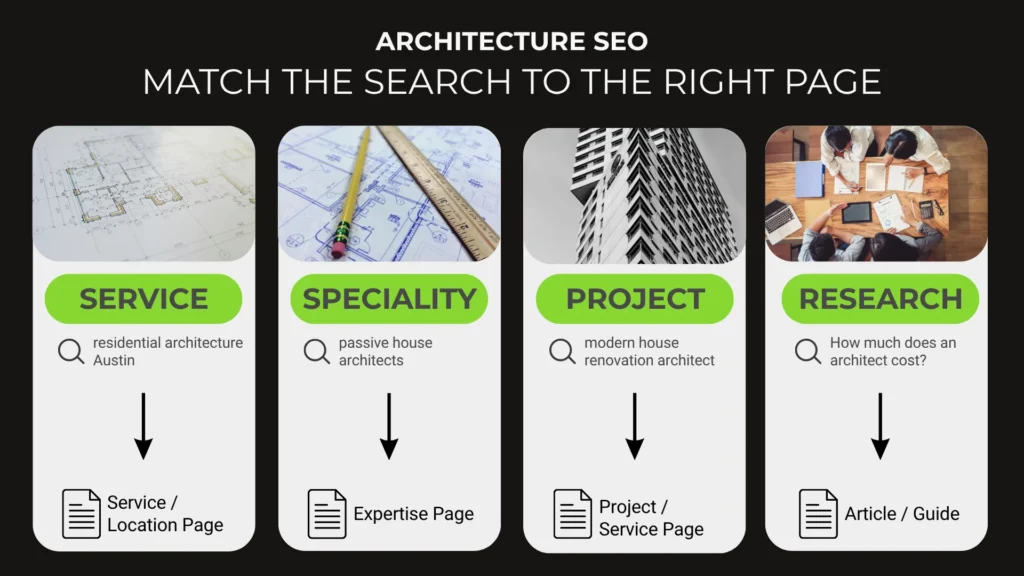
Potential clients don’t all search for an architect in the same way. What they type into Google usually depends on what they need, where the project is, and how far along they are in choosing a firm.
Understanding those differences helps you create pages around real search intent instead of trying to make one homepage rank for everything.
Service and Project-Type Searches
Potential clients may search directly for the type of architect or project they need:
- residential architect
- commercial architecture firm
- hospitality architect
- architect for home renovation
These searches are usually closer to hiring intent because the person already has a clearer idea of the type of architectural work they need. For SEO, they can help determine which services or project types deserve their own clear place on the website.
Location-Based Searches
For firms working within a defined geographic area, potential clients may add a city or region:
- residential architect in Austin
- architecture firm in Chicago
- commercial architect in San Diego
If location influences who you can realistically work with, it should also influence your SEO strategy. We’ll cover this in more detail in the local SEO section.
Specialty and Expertise Searches
Some clients search by a particular type of expertise rather than a broad architectural service:
- passive house architect
- historic preservation architect
- sustainable architecture firm
- adaptive reuse architect
For a specialist practice, these narrower searches can be more valuable than ranking for a broad term like architect.
Research Searches
Not every potential client is ready to hire when they first search. They may begin with questions about planning a project, costs, timelines, permits, materials, or the architectural process.
Those searches are where useful educational content can introduce someone to your firm before they’re comparing architects directly.
The goal isn’t to target every possible architecture-related search. It’s to understand how the clients you want move from researching a project to looking for the right firm, then make sure your website has useful pages at the relevant stages.
Build an SEO Strategy Around the Work You Actually Want
Before choosing keywords or creating new pages, decide what you actually want SEO to bring to the firm.
An architecture practice trying to win more residential renovations needs a different strategy from one pursuing hospitality projects or specializing in sustainable commercial design. Ranking for a keyword is only useful when that search is connected to work you genuinely want.
A simple way to approach an SEO strategy for architects is:
Business goal → Desired project type → How clients search → Best page to answer that search
For example:
| Business goal | Search theme | Best page |
|---|---|---|
| Win more residential projects | residential architect + location | Residential architecture page |
| Attract hospitality work | hospitality architecture firm | Hospitality service/expertise page |
| Grow a specialist niche | passive house architect | Dedicated expertise page |
| Increase local enquiries | architect + city | Relevant location/service page |
| Build trust around completed work | specific project types | Detailed project pages |
This keeps SEO tied to the firm’s actual business goals rather than creating content simply because a keyword has search volume.
It also gives you a clearer way to prioritize. If a service represents an important part of your business but the website barely mentions it outside a few project captions, that’s usually a better place to start than publishing another general blog post.
The question isn’t “What can we rank for?” It should be “What do we want to be hired for, and how are potential clients searching for it?”
Choose the Right SEO Keywords for Your Architecture Firm
Once you know what kind of work you want to attract, the next step is finding the searches that connect potential clients with that work.
The best keywords aren’t necessarily the ones with the highest search volume. A broad term such as “architect” may get more searches, but it tells you very little about what the person actually needs.
More specific searches can reveal much stronger intent:
- residential architect in Boston
- hospitality architecture firm
- sustainable architect in Seattle
- historic preservation architect
- architect for home renovation
For an architecture firm, keyword research should usually consider four things:
Relevance. Does the search actually describe work your firm provides?
Intent. Is the person researching architecture, looking at inspiration, or potentially searching for a firm to hire?
Location. Does geography matter for this particular service or project type?
Specificity. Would a more specific search better represent the kind of client or project you want?
You also don’t need to repeat the same keyword everywhere. A residential architecture page, for example, can naturally explain the firm’s residential work, locations served, project types, approach, and relevant experience without forcing the exact same phrase into every heading.
The goal of keyword research isn’t to collect as many SEO keywords for architects as possible. It’s to identify the searches that matter to your firm and give each important search intent an appropriate place on the website.
That’s what we’ll look at next.
Map Each Search Intent to the Right Page
Finding the right keywords is only half the job. The next question is: which page should rank for each search?
One common mistake is expecting the homepage to rank for every service, specialty, location, and project type the firm offers. A clearer site structure gives each important search intent a more relevant destination.
For example:
| Search | Search intent | Best destination |
|---|---|---|
| residential architect Austin | Looking to hire | Residential architecture / location page |
| hospitality architecture firm | Looking for a specialist | Hospitality architecture page |
| passive house architect | Looking for specific expertise | Passive house / expertise page |
| modern home renovation Austin | Exploring a specific project type | Relevant service or project page |
| how much does an architect cost | Researching before hiring | Educational article |
Think of it as one clear search intent → one useful destination.
That doesn’t mean creating a new page for every slightly different keyword. Searches with the same underlying intent can usually be covered by one strong page. Creating dozens of near-identical pages for small keyword variations can make the website harder to navigate and create unnecessary competition between your own pages.
Instead, build around genuinely different needs. Your homepage can introduce the firm, service pages can explain what you do, project pages can prove you’ve done it, and educational content can answer the questions clients have before they’re ready to enquire.
This also makes internal linking much more useful: a relevant article can lead to a service, that service can lead to completed projects, and those projects can give a potential client the evidence they need to take the next step.
Turn Architecture Project Pages Into Search Assets
For many architecture firms, the portfolio is the strongest proof of their work. But a project page made up of a project name, a location, and a gallery of images gives search engines—and potential clients—very little context.
You don’t need to turn every project into a long case study. You do need to explain enough for someone to understand what the project was and what your firm contributed to it.
What an SEO-Friendly Architecture Project Page Should Explain
Where relevant, include:
- Project type: residential, commercial, hospitality, mixed-use, renovation, etc.
- Location: city or region when appropriate.
- The brief: what the client needed or what the project needed to achieve.
- Scope: the architectural services your firm provided.
- Approach: important design decisions or challenges you worked through.
- Key details: materials, sustainability considerations, site constraints, preservation requirements, or other genuinely relevant details.
- Outcome: what was ultimately created or improved.
The photography should still be central to the page. The written content simply gives that work context.
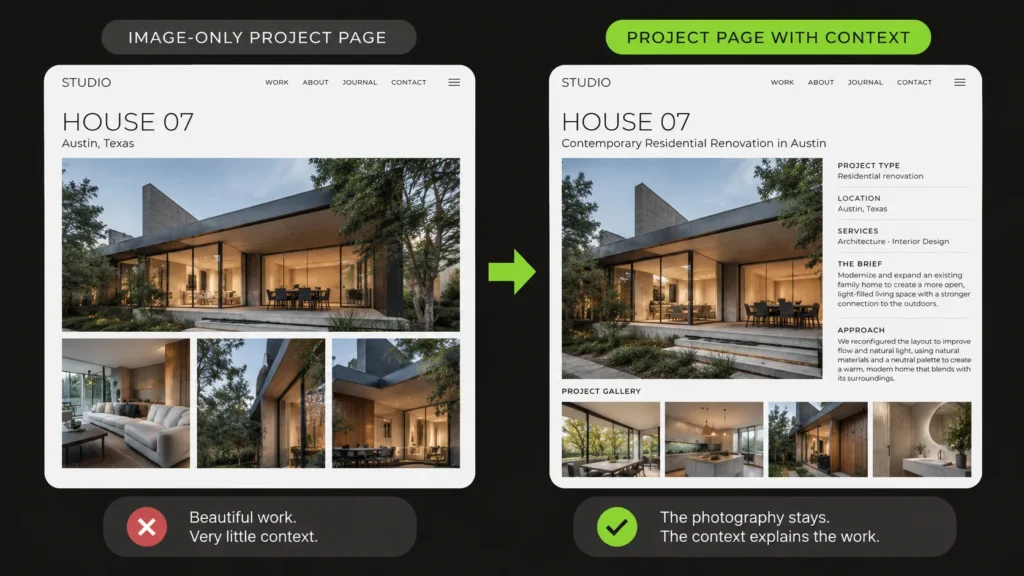
Instead of a page that effectively tells Google:
Project X — (GALLERY)
you create one that communicates:
Residential renovation in Brooklyn → client brief → architectural approach → services provided → completed project
That also creates natural opportunities to link the project to the relevant service, expertise, location, or related work elsewhere on the site.
The point isn’t to add text for SEO’s sake. A strong project page should help a potential client understand why that particular project is relevant to the work they’re considering. Search visibility becomes a benefit of providing that context well.
Structure the Architecture Website Around Services, Expertise and Projects
Strong project pages work better when the rest of the website gives them a clear place to live.
An architecture website shouldn’t rely on one large portfolio to explain everything the firm does. Ideally, the structure connects services, areas of expertise, and completed projects so visitors can move naturally between them.
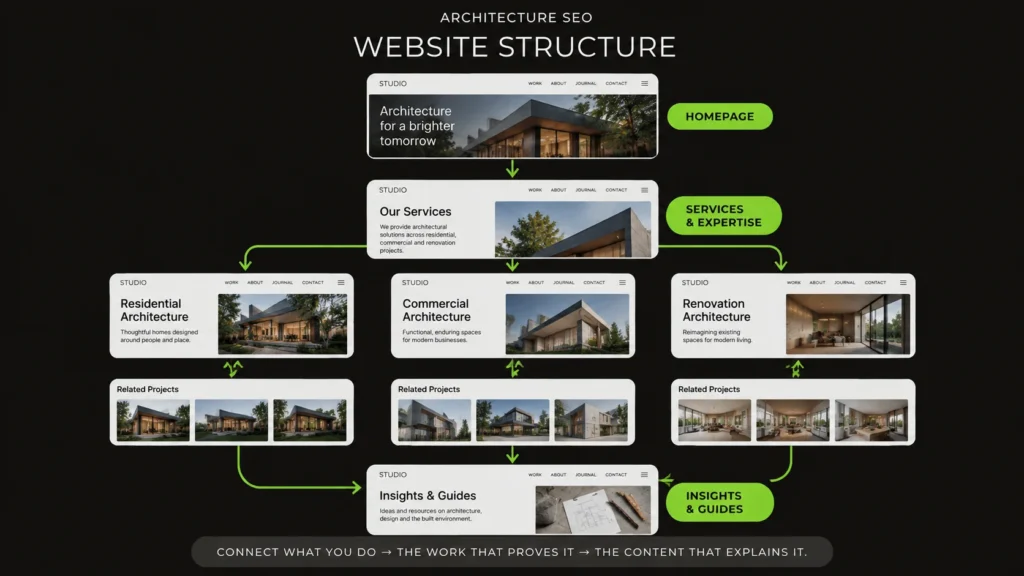
A simple structure might look like:
Homepage
↓
Services / Expertise
↓
Relevant Projects
↓
Related Insights or Resources
For example, a residential architecture service page could explain the firm’s approach and then lead visitors to relevant residential projects. Those project pages can link back to the service they demonstrate and to similar work.
This creates useful internal links, but more importantly, it helps potential clients understand the relationship between what you say you do and the work that proves you can do it.
You don’t need a complicated website hierarchy or dozens of service pages. Build separate pages when there is a genuinely distinct service, specialty, or search intent to satisfy, not simply because you’ve found another keyword variation.
For architecture firms with large portfolios, clear structure also prevents strong projects from becoming buried several clicks deep inside galleries or filters where both visitors and search engines may struggle to discover them.
Local SEO for Architects
For architecture firms that serve a specific city or region, local SEO for architects can help the firm appear when potential clients search for architectural services nearby.
Start with the basics: keep your Google Business Profile accurate and complete, make sure your business details are consistent across relevant directories, and encourage genuine client reviews. Your website should also make it clear where you work, rather than leaving visitors to figure it out from project addresses.
Completed projects can strengthen that local relevance too. If a project page genuinely relates to a location, include the city or region naturally alongside the project type and details. A portfolio of residential projects in the same area can provide much stronger evidence of local experience than repeatedly inserting a city name into generic website copy.
Location pages can also make sense when your firm has a real presence or meaningful body of work in different markets. What you want to avoid is creating dozens of nearly identical city pages simply to target variations of architect + city.
And not every architecture firm needs the same local SEO strategy. A residential practice working primarily within one metro area may depend heavily on local visibility, while a specialist firm working nationally or internationally may benefit more from building authority around its expertise.
Your local SEO strategy should reflect how and where your firm actually wins projects.
On-Page SEO for Architecture Websites
Once the right pages are in place, make it easy for both visitors and search engines to understand what each page is about.
For architecture websites, the fundamentals of on-page SEO are fairly simple:
- Give each important page a clear, descriptive SEO title and H1.
- Use short, readable URLs that describe the page.
- Write a useful introduction instead of opening immediately with a gallery.
- Organize longer pages with descriptive H2 and H3 headings.
- Write a compelling meta description that accurately represents the page.
- Link naturally between relevant services, projects, expertise pages, and articles.
- Use descriptive image alt text when it helps explain what an image shows.
- Avoid creating multiple pages targeting essentially the same search intent.
Project names are worth paying particular attention to. A page titled only “House 07” may make sense within the firm’s portfolio, but it tells someone arriving from Google almost nothing about the project.
You don’t necessarily have to rename the project. Instead, add context around it:
House 07 — Contemporary Residential Renovation in Austin
The original identity remains, while the page becomes much easier to understand.
The same principle applies throughout architect SEO: optimize for clarity first. Keywords should help describe the page accurately, not make the writing sound as though it was created for an algorithm.
Image SEO Without Ruining the Portfolio
Architecture websites depend heavily on photography, renders, and large project galleries. Those visuals are essential to the portfolio, but poorly optimized images can also make pages slow and difficult to use.
The goal of image SEO isn’t to reduce the visual impact of the website. It’s to deliver those images efficiently and give them useful context.
For each important image:
- Use a descriptive filename instead of something like IMG_4827.jpg.
- Write alt text that describes what the image actually shows when alt text is appropriate.
- Compress large images before uploading them.
- Use efficient formats such as WebP or AVIF where appropriate.
- Serve images at suitable dimensions rather than loading an oversized file and shrinking it in the browser.
- Use responsive images so mobile visitors don't download unnecessarily large files.
- Lazy-load images further down the page, while being careful with the main above-the-fold image.
Alt text shouldn’t become a place to insert as many keywords as possible. For example:
Poor:best residential architect Austin architecture firm modern architect
Better:Rear extension of a contemporary residential home in Austin
The second version describes the image for someone who cannot see it while also providing meaningful context naturally.
For image-heavy architecture websites, good image optimization supports both search visibility and user experience. You can keep the large, high-quality project photography, the important part is making sure visitors don’t have to pay for it with an unnecessarily slow website.
Technical SEO for Image-Heavy Architecture Websites
Architecture websites often use large images, video backgrounds, animations, interactive galleries, and portfolio filters. These can create a strong visual experience, but they can also introduce technical problems if they’re not implemented carefully.
Pay particular attention to:
- Page speed and Core Web Vitals, especially on project pages with large galleries.
- Mobile performance, where oversized images and video can have an even bigger impact.
- Crawlability, so important services and projects can be reached through normal internal links.
- Indexability, making sure pages you want in search aren't accidentally blocked or set to noindex.
- Portfolio filters and archive pages, which can create unnecessary or duplicate URLs.
- Broken links and redirects, particularly after redesigning or restructuring the portfolio.
- XML sitemaps and canonicals, so search engines receive clear signals about the pages you want indexed.
A visually ambitious website doesn’t have to be a slow website. Many performance problems come from how media is delivered rather than from the decision to use high-quality photography itself.
Technical SEO also becomes particularly important during a website redesign. Changing project URLs, removing old pages, or restructuring the portfolio without a plan can erase search visibility the existing site has already earned.
If you’re planning a larger rebuild, our website redesign checklist covers what to audit, preserve, test, and monitor before and after launch.
Content SEO for Architects: Write About the Questions Behind the Project
Publishing blog posts can help an architecture firm build organic visibility, but only when the content answers questions potential clients actually have.
A useful place to find those topics is inside your existing projects. Think about the questions clients asked, decisions they struggled with, constraints that affected the design, and problems your team had to solve.
For example, a historic apartment renovation could support content about:
- what to consider before renovating a historic property
- common planning or preservation constraints
- how to approach modernizing an older home
- what to prepare before speaking with an architect
The project page shows what you created. The article demonstrates what you know about the problem behind it.
This also creates a natural internal linking structure. An educational article can lead readers to the relevant architectural service and completed projects, while those pages can point back to useful resources when someone wants to learn more.
You don’t need to publish every week simply to keep the blog active. For an architecture firm, a smaller library of genuinely useful articles based on real expertise, client questions, and project experience is far more valuable than publishing generic architecture content just to target keywords.
How Architecture Firms Can Build SEO Authority
A well-optimized website is only part of SEO. Search engines also look for signals that help establish the firm and its work as credible and relevant.
For architecture firms, some of the best opportunities to build that authority already exist around completed projects and professional relationships.
These can include:
- Features in architecture and design publications
- Project awards and competition listings
- Profiles from relevant professional organizations
- Local press coverage for notable projects
- Features from manufacturers or suppliers used in a project
- Genuine partnerships with developers, builders, designers, or other industry professionals
- Expert commentary or contributions to relevant publications
When these mentions include a link to your website, they can also strengthen the site’s backlink profile. But the goal shouldn’t be collecting links from anywhere that will give you one.
A feature about one of your projects on a respected architecture publication is far more relevant than dozens of links from unrelated directories.
Your own work can create opportunities too. Original project photography, detailed case studies, research, useful resources, and genuinely interesting design insights give other websites a reason to reference the firm in the first place.
For architecture firms, the strongest link-building strategy often starts with work worth talking about—and making that work easy to discover, understand, and reference online.
How to Measure Whether Architect SEO Is Working
SEO performance shouldn’t be judged by traffic alone. For an architecture firm, the more important question is whether organic search is bringing the right people to the right parts of the website.
Track metrics such as:
- Non-branded search visibility for relevant services, specialties, project types, and locations
- Google Search Console queries showing how people are actually finding the site
- Organic traffic to important service and project pages
- Enquiries and consultation requests originating from organic search
- Which pages contribute to those enquiries
- Changes in rankings and visibility for the searches you've intentionally targeted
Pay attention to quality as well as quantity. A large increase in visitors looking for architecture inspiration, definitions, or student resources may look impressive in an analytics report without creating any meaningful business value.
On the other hand, a smaller number of visitors discovering your residential, hospitality, or specialist architecture pages could be much more valuable if those searches match the projects your firm wants to win.
The goal of architect SEO isn’t maximum traffic. It’s greater visibility among the people most likely to need your expertise.
What This Looks Like on a Real Architecture Website
When we worked on the SMARX architecture website, the challenge was similar to what many architecture firms face: the website needed to let the projects remain visually dominant while still giving the portfolio a clear structure.
Architecture websites can easily become collections of impressive images without enough context connecting one project to another or explaining the firm’s broader expertise. With SMARX, the focus was on creating a website where visitors could explore the work clearly without losing the visual character expected from an architecture portfolio.
The project reinforced a few principles that also matter for SEO:
- Give individual projects their own clear place within the website.
- Organize the portfolio so important work is easy to discover.
- Use written context alongside visuals rather than relying entirely on images.
- Keep navigation and content hierarchy clear even when the website is highly visual.
- Make the experience work well across desktop and mobile.
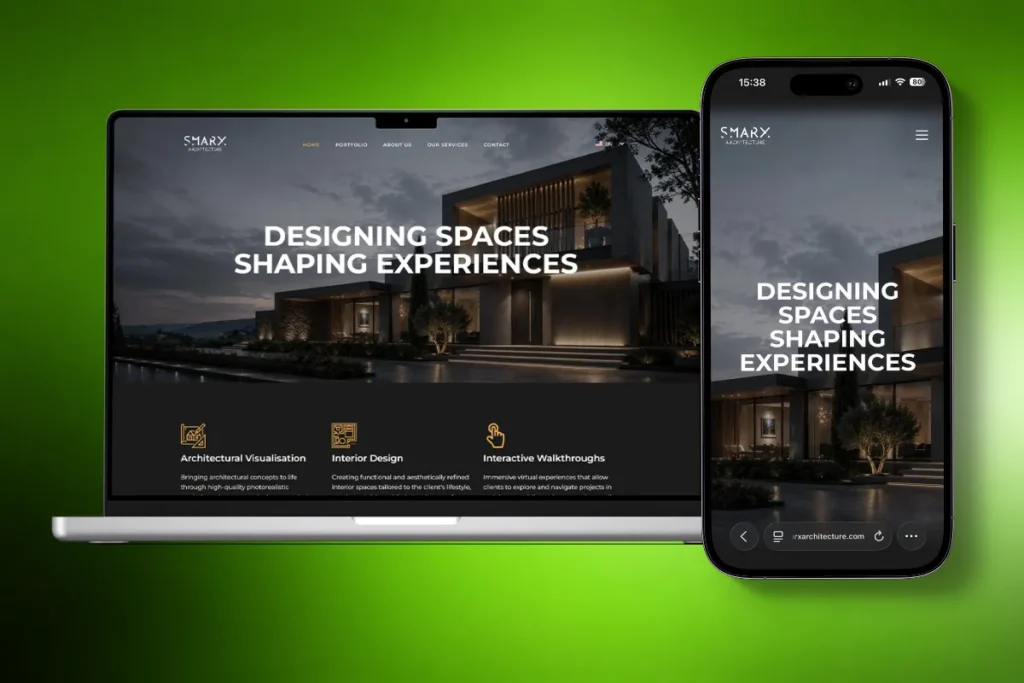
This is also why we don’t see SEO and web design as completely separate jobs. Decisions about site structure, project pages, navigation, content, images, and performance can affect search visibility long before someone starts optimizing individual keywords.
The goal isn’t to make an architecture website look like an SEO website. It’s to make sure the design still gives both potential clients and search engines enough information to understand the work.
If You're Starting SEO for an Architecture Firm, Do These First
SEO can quickly turn into a long list of things you could improve. If you’re starting from scratch, don’t try to tackle everything at once.
Start with the areas most closely connected to the work you want to win:
- Set up your measurement. Make sure Google Search Console and GA4 are working so you have a baseline before making changes.
- Audit what already exists. Check which pages are indexed, what the website already ranks for, and whether any projects or services are already receiving organic traffic.
- Choose your priority services and project types. Decide what you actually want the firm to become more visible for.
- Research how potential clients search for that work. Look at intent, location, specialties, and project types, not just search volume.
- Map those searches to pages. Improve an existing page where possible and create a new one only when there is a genuinely different intent to serve.
- Improve your strongest service and project pages first. Add useful context, strengthen internal links, and make sure each page clearly communicates its purpose.
- Fix major technical and performance problems. Prioritize issues that affect crawling, indexing, mobile usability, or the experience of viewing image-heavy pages.
- Strengthen local visibility if geography matters to your firm. Optimize your Google Business Profile and make your locations and service areas clear.
- Create useful content from real client questions and project experience. Expand only after the core website gives that content somewhere meaningful to lead visitors.
You don’t need to publish dozens of articles or redesign the entire website before SEO can start making sense.
Start with the pages closest to the work you want to win, make those pages genuinely useful, measure what happens, and expand from there.
SEO for Architects FAQs
Does SEO work for architecture firms?
Yes, especially when the strategy focuses on searches related to the firm’s actual services, specialties, project types, and locations. SEO can help new prospects discover an architecture firm and help referred prospects research the firm before making contact. The goal should be qualified visibility rather than simply increasing website traffic.
How long does SEO take for architects?
There isn’t a fixed timeline. Results depend on factors such as the website’s current authority, competition, technical condition, existing content, location, and the keywords being targeted. Some improvements may appear relatively quickly, while competitive searches can take months of consistent work. Use Google Search Console to monitor whether relevant impressions, rankings, and clicks are moving in the right direction before judging SEO only by enquiries.
Do architects need local SEO?
It depends on how the firm wins projects. Local SEO can be particularly valuable for architects serving a defined city or region, while firms working nationally or internationally may need to place more emphasis on services, specialties, and industry expertise. Your SEO strategy should reflect the geographic reality of your business.
What keywords should architects target?
Architects should prioritize keywords that reflect the services and projects they want to win. That can include combinations of service, project type, specialty, and location, such as residential architect in Austin or historic preservation architect. Relevance and search intent are generally more useful than choosing keywords simply because they have high search volume.
Can an architecture firm do SEO itself?
Yes. An architecture firm can handle many SEO fundamentals internally, including improving project descriptions, creating useful content, optimizing its Google Business Profile, strengthening internal links, and monitoring Google Search Console. More complex technical issues, keyword strategy, site architecture, or competitive SEO may require specialist support, but you don’t need an agency to make every SEO improvement.
Want More of the Right People to Find Your Architecture Firm?
A strong architecture website should do more than showcase your work. It should help potential clients discover your firm, understand your expertise, and see why your experience is relevant to their project.
At MaTox, we combine website design, development, and SEO to build websites around both the work you want to showcase and the clients you want to reach.

About the Author
Makedonka Tochevska
Makedonka Tochevska is a web designer and front-end developer at MaTox Digital Agency. She works on website design and redesign projects with a focus on WordPress development, user experience, website performance, and SEO implementation.
Her work includes planning and building business websites, improving existing websites, and handling the technical and SEO details that need to be considered when a website changes.